2.4
Schooling
Little London Infants
School: Shortly after arriving in Yorkshire I started at the infant’s
school in Little London, on Micklefield Lane and
almost opposite the Baptist Chapel. It was run by “the Miss Simms”, two sisters
who came from Guiseley (if my memory is correct, they went to Guiseley Baptist
Church – certainly my father knew them well), and there were two classrooms,
outside toilets, slates and chalk, and very occasionally such luxuries as paint
and cardboard.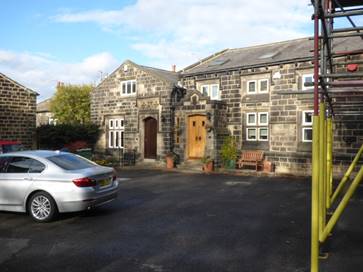 The school is no more; it was converted into a private house (pictured in
2018).
The school is no more; it was converted into a private house (pictured in
2018).
Littlemoor Primary School: This was the primary school, where we were from age 7 to 11 (1950-54). The first teacher I had was Miss Grace Verity, the sister of the famous Yorkshire cricketer Hedley Verity, and the Auntie of one of my friends, Arthur Winfield, and she taught us to write (i.e. “joined up writing”). We had free school milk at morning, in 1/3 pint bottles, with cardboard bottle-tops, and I remember we had spells of a week at a time as “milk monitor” (i.e. go out and bring in a crate of milk bottles for the class, then remove the empties afterwards). I was “volunteered” to read a poem at the 1950 Prize Day[28], and I chose “Market Square” – clearly Pooh Bear was part of my home reading by that time. The headmaster was a Mr Jackson, who had black hair brushed directly back from his forehead (rather like badger’s fur, I thought), and another teacher was Mr Harry S Jones (father of another friend, Roger).
Our second year was with a Miss
Wood, who I remember as “young and nice”, and the third year with a Miss Busfield (another Guiseley teacher, definitely not young) –
she had an unerring aim with a piece of chalk, and any of us misbehaving would
suddenly realise we’d been spotted as a piece of chalk landed on our head or
chest[29].
Then the fourth and fifth years, leading up to the 11+ exam, was taught by a Mr
Wright, and we seemed to be VERY busy that year. Other teachers there were Mr Kirkbright, who amongst other things taught music – he was
a competent pianist, and we learned a lot of folk songs, such as “the Bluebells
of Scotland”, “Come to the Fair” and so on (he left, I think in my final year,
and Rosalie and Katie had Mrs Rigg for music), and Mr
H S Jones. Most half-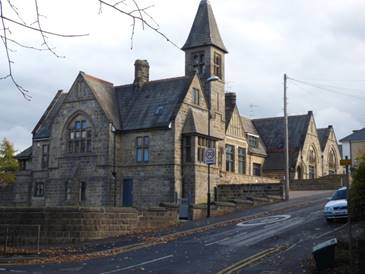 yearly
reports had me in the top 4 of the class.
yearly
reports had me in the top 4 of the class.
Littlemoor had a “house” (or teams) system; Bronte (blue), Priestley (red, my team), Verity (green, Katie’s team), and Cook (yellow); all named after famous Yorkshire people.
It was at Littlemoor that I heard about the death of King George VI (the school was immediately closed, and I ran home – my parents were surprised to see me, as they had not heard the news), and later we did “projects” in preparation for the Coronation of Queen Elizabeth II, both described later. At the back of the school was an air-raid shelter (we were perhaps only a mile from the Yeadon airfield and aircraft works), all locked up and (allegedly) out-of-bounds. The school had a bell – a hand-bell to summon us inside after breaks, and a large bell in a tower to hurry us to school at the start of the morning and afternoon sessions, pulled by a rope and audible over most of Rawdon. The building is also now used for housing (the picture on the right was also taken in 2018), but the external appearance of the building hasn’t changed much..
The school had an annual Sports Day[30] … mainly a “house” competition (I was in Priestley – red), and we all wore our house colour in the form of a braid … featuring such “Olympic” events as the sack race, egg-and-spoon, and obstacle races, as well as the more prosaic 50 yards and relay races; what is now the Benton Park Secondary school was in my days the Littlemoor sports field. Then there was a summer “school trip” in late May or June, which we would prepare for some weeks in advance[32] and “write up” afterwards; I remember in the early years we went to Ilkley Moor (and the White House), and in later years we went to York (1952), Liverpool (1953 - including a trip on the “overhead railway” above the docks), and Chester (1954).
While we were there, the school produced a cine film “Portrait of Littlemoor” featuring most of us, and this was shown on April 3rd 1952; I wonder if it still exists.
The culmination of life at Littlemoor was the 11+ exam, my first exam using printed question-papers (copied paper work was produced by duplication at that time). I can’t remember much about it, but I think there were three papers; an IQ test, a maths test and an English test. Those of us that “passed” went to Aireborough Grammar School (except for a few who sat the entrance exam for Woodhouse Grove, a local private Grammar school for which there were a few scholarships, or even fewer who went to Ilkley Grammar School); the rest went to Benton Park Secondary modern (a new building was built during my last year at Littlemoor). But there was a system whereby after about 2 or 3 years, the “late developers” at Benton and the “trailers” at Aireborough swapped schools, and I believe my friend Arthur Winfield came to Aireborough through that route.
Aireborough Grammar School: As always, going from being “big boys” at school A to “new boys” at School B was traumatic – and not helped by “horror stories” in advance, about how new boys would be dropped down the frog-hole (a sunken area outside the swimming pool windows), which of course had been much exaggerated in the telling. But it was still strange and different in a number of ways, not least being the transition to long trousers! Other changes we had to get used to – having a different teacher for each subject, having homework to do, and getting to know new pupils from a much wider geographical area than we’d been used to (the school served all 3 townships of Aireborough, plus Horsforth and Menston).
In the first year we started learning French, and then in year 2 we added either German (for those with a lesser aptitude for French) or Latin (for those good at French – I’ve never understood the logic of this); so I started Latin, being taught by Mrs Curry, our next-door neighbour[33]. After three years at the school, we started “streaming” ready for GCE O-levels, and I took the science stream (Maths, Physics, Chemistry, English language and literature, French and Latin – 7 subjects in all). Then in the 6th form I was one of a group of 6 doing a “revolutionary” 3-subject specialist course – Maths, Further Maths and Physics (and I even did scholarship papers in Maths and Further Maths as well); the Maths teacher, Mr Pollard, was a member at the Cragg and often played the piano (in the Winter months, when the schoolroom was used for services) and occasionally also the organ.
One of the stories concerning AGS happened while I was in the 2nd or 3rd form. Our lodger, Nigel Clarke, was doing 6th form biology, and had to dissect a pregnant white rat – unfortunately, the biology mistress (or possibly the supplier) miscalculated, and just before Easter she opened a parcel from the labs to find one mother rat and 13 babies. Nigel volunteered me to look after the lot during the Easter holiday (I think one baby died, that was all), then after the holiday, the babies were distributed round our class, and I kept the mother as a pet. Nigel had to wait to do his project.
I’ve written elsewhere about the musical side of life at AGS, but not about drama. The school put on an annual play or musical item, and I remember in my first year they did “The Merchant of Venice”[34], and in the second year Purcell’s “Dido and Aenaeus”. I first became involved in the 3rd year, taking the very minor part of Abraham[35] in “Romeo and Juliet” – and I found that by the time the play went on, in April 1957, I could repeat the entire play from memory (without really trying[36]). In the fourth year I was sought out by another English teacher, Mr White (who didn’t teach us until the 5th year) to play the main part in a J B Priestley play “I have been here before”; the silly thing was that I, who had not even started school German, was playing a character with a German accent – so one of the German teachers spent some time with me, teaching me to speak in English with a German accent. The next year (March 1959) it was back to Shakespeare, and I was Claudius (the villain) in “Hamlet” – a really demanding role[37], but far less so than Hamlet himself, who was on stage over half the time. It was definitely School drama that gave me my interest in the Theatre. In my lower sixth year, April 1960, it was Edward German’s “Merrie England”, and I was Walter Wilkins – a comic role that I thoroughly enjoyed. In the upper sixth they did “Macbeth”, and we were severely told off for showing any interest in the play – being supposed to be revising for our A-levels! Programmes for all the plays I was “in” are in the archive, and photos with names are in a Word file on the computer.
I was never much of a sports person – the gym and cross-country runs were simply torture – but I did enjoy the school swimming baths (despite being so shallow at the shallow end that we scraped our knees regularly), and enjoyed trying some of the field sports (javelin, discus etc) in the summer. But the real social events at Aireborough were the “dances”. Each year had a Christmas party, and amongst a number of games (notably “Albert and the Lion”, the Stanley Holloway poem turned into a team relay race) we were introduced to a few folk dances by two of the teachers, who were enthusiasts. Obviously, we lads made a right hash of things, which so annoyed the girls that they pestered two of the teachers to hold “practices” in the hall at lunchtimes, and dragged us along. Well, the next development was ballroom dancing at the Christmas parties – quickstep, waltz, veleta and barn-dance to start with – so naturally we asked if we could practice those too; thus the dance club was born. We used records by Joe Loss and Victor Sylvester in the main, and two of the teachers (Mr Frost who taught French, and the sports mistress Miss Dean) taught us the steps. You can imagine the mixture of eagerness and embarrassment, in dancing with girls, especially as “such close contact” was actually being encouraged by teachers; quite a few close friendships resulted. After a while, they wanted to add rock-and-roll dancing to the syllabus, but no-one could afford to buy the records, so I started playing the piano, playing the pop music of the day from memory (having heard the songs on the radio). To a modern teenager, this sounds “impossible”, but pop music[38] was far more tuneful then than it is today, and the piano (played imaginatively) was fine – at least, the others said so. But of course, while they all learned to dance to pop music, I never did.
What was nice, at this stage of my life, was that most of my friends shared three common interests – school, scouting/guiding, and church youth fellowships; there were so many friendships where all three overlapped, that these associations were never “separate compartments”.
It seems to be becoming fashionable to decry ones teachers; I had one or two poor ones … notably the history teacher we had in our first year (whose idea of teaching history consisted of writing a chapter heading on the blackboard, then leaving us to read the chapter and write an essay on the subject of the chapter, while he read his Manchester Guardian and sometimes ate an apple), but on the whole they were good. Among those I remember with the greatest respect and affection were Mrs Curry[39] (our next door neighbour) who was not able to resist laughing at our jokes, and who made school fun (but brought us back to Latin or English quickly), Mr White (who taught us English in our GCE year, and impressed on me his love of the language and literature), Mr Northin (woodwork – a stool I made at school is still in use here in the hall, as a telephone stool[1]) and of course Mr Pollard (maths).
The headmaster, Mr MacDonald, was a fairly stern man, but I think basically fair. We all treated him with respect, and to be summoned to his study was not a casual matter! He administered the cane occasionally[40] – each time announcing in assembly the culprit and his crime in advance, so we all knew the sort of things that warranted such punishment; I remember the time he was really angry, a case of someone bullying a lad who had a glass eye. He took us for RE and took the assemblies; I don’t remember the RE lessons much (perhaps because I knew all the basics from church), but I remember vividly how dreadful the assembly services were – there was a “read” service for each day of the week, a la Anglican liturgy, with verses and responses; to me, the weekly repetition was boring beyond belief, and I’ve never really liked Anglican liturgy since; what it did to kids with no Christian parents, I hate to think.
Mr Pollard discovered that some of us (in my year) were interested in amateur radio – notably my friend John Credland and his friend Bryan Blackburn – and helped us set up our “radio club”; this involved taking over a disused corner of the cellar, fitting it up with benches and power sockets, and then bringing in lots of old government surplus electronics, and making useful equipment out of it. We sometimes took a new chassis and cut holes for the valve-holders, but more often than not just adapted the original chassis. Valves were relatively cheap (about 1s 6d in the Leeds markets) and lasted well. A favourite scheme was to get a surplus CR100 (Marconi military radio), get it to work, then add all sorts of enhancements such as a tuning indicator, signal strength meter, and so on. There was a long application list to join the club, but numbers were strictly limited – some wanted to join because the club “den” was next to the girls PE changing rooms! One of the boys in the radio club was Paul Roper (known affectionately as “Puff” for reasons I am about to narrate). Paul had taken an interest in television, and wanted to design and build his own set, and indeed did so … but this involved lots of tests on existing TV sets, and in the course of these Paul accidentally touched the EHT bus (extra high tension – a power source carrying 7,000 to 16,000 volts to the picture tube). Now while most people get a severe jolt from 240v mains power, and indeed for some it could be fatal, Paul found that EHT voltages affected him hardly at all – a number of tests were done, and he had an unusually high body resistance. So he got quite casual, and would check the voltage on the EHT lines of TV sets by “manual testing”, i.e. touch with a licked finger (I can remember him saying “yes, that’s about 14kv”). Several years later, when I was working for the CEGB in Leeds, I visited Kirkstall power station, and found that Paul worked there – and was applying his “rule of thumb” power measurement techniques to grid voltages right up to 400,000 volts (much to the amazement and wry amusement of his colleagues).
Several of Mr Pollards’ remarks remain with me to this day, but one in particular grabbed my attention; we had been doing a bit of algebra and logic, and in connection with binary numbers he had been describing “new inventions” called computers – “one day”, he said, “every home will have one”; this was in 1959-61, before even many businesses had them, and was hence a very far-sighted remark.
All through school, I was in or near the top 5 of the top class – and I think the teachers expected me to get a string of “A” grades at O-level. But for some reason, while my internal exam results and “mock” grades were excellent, on the day of the exam my results were well below expectations. The same thing happened at “A” level. I never felt nervous of the genuine exam, nor did I feel over-confident either – it is a total mystery, and has affected all my formal exams right up to and including the degree finals.
Looking through the speech day programmes, I see that I won the form prize in the third year, a special service prize for drama in the fifth year[41] (following “Hamlet”), and one of the Parents Association prizes (for general worth!) following the upper sixth year[42].
Sadly, the school was closed in 1978?, demolished and the site used for housing – they retained 4 carved stones bearing the words Rawdon, Yeadon, Guiseley and Menston and these are in the road-side wall; the close of houses has retained two of the house names (Coverley and Fairfax). So all three of my schools have now disappeared in favour of housing.
Link forward to next chronological or next on this subject : link backwards to previous chronological, to the Introduction, or to family documents index.
[28] Mr MacDonald, headmaster at Aireborough GS, was the guest of honour.
[29] According to one of Martin Riggs “Aireborough” books, she must have downgraded from throwing blackboard rubbers, to the less traumatic and damaging chalk.
[30] The programme for the 1950 event was the “First” Annual Sports Day
[32] Ending up with a duplicated notebook, which we took on the trip with us.
[33] Her father, Mr Lacey, was the local blacksmith – his shop was on the corner of Apperley lane and Warm Lane.
[34] Of great interest to Mum and Dad, because Bassanio was played by Leslie Harrison, a lad from their church in Guiseley.
[35] The main dialogue of the part was a conversation about biting thumbs, but I did get to do fencing as part of the play.
[36] I have retained a love of Shakespeare to this day, and I’m sure that having been involved in a production before studying a Shakespeare text in “English Lit” helped considerably.
[37] Mrs Curry produced this, and indeed all the Shakespeare plays; Russell Peakman (Hamlet) and I were taken to her home (then in New Road Side, Rawdon) and she played us LP recordings of Laurence Olivier’s Hamlet.
[38] Songs at this time included “Cathy’s Clown” by the Everley Brothers, and the piano music of Russ Conway.
[39] We have just heard that she died recently (Feb 2002).
[40] Perhaps once a year – hardly the “Wackford Squeers” experience that my great-grandfather recounts.
[41] I bought a book on valve-technology radio.
[42] This furnished one of my Maths textbooks for college – a book on “Dynamics”.