2.5
Music
I cannot remember much music in the home, during my early years. There must have been some – my parents had a valve radio, and while I remember them listening to news, I do not remember much in terms of broadcast music. Of course, there was music at church – the Cragg at Rawdon had a fine 2-manual organ, and Margaret Hardisty the organist was more than competent. Perhaps they listened to the Messiah on the radio, or similar concerts, I do not know. I remember that they often went to hear oratorios in Bradford, at the invitation of Mrs Hardisty (the choir-mistress at the Cragg, and mother of the organist), who was a member of the Bradford Festival Choral Society[43].
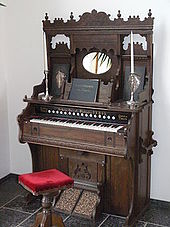
What we did have was an “American Organ”, something like a harmonium, with one manual and bellows-pedals, and Dad used it to try out a hymn tune, or play, occasionally, for his own amusement. To play it, you pumped with your feet, played the keys, and pulled out and pushed in a few stops; then by each knee was a lever that caused different effects. The picture on the left (culled from the internet) is similar to ours, but ours didn’t have the elaborate screen above the keyboard. Amongst the stops were octave couplers. Anyway, to a young lad of 5 or 6 it was irresistible, and propped up with a cushion on top of the stool, I explored all the sounds as best I could. About age 7 I had grown to the point where my feet could reach the pedals and my fingers the keys, both at the same time! So my father started to teach me to read music, to the point where I could play simple 4-part pieces such as hymns. After that I guess I was picking up whatever music there was in the house; cantatas, albums of folk songs, and so on – and just played and played.
It must have been about the age of 12 when several things happened in quick succession that affected my musical interests. Firstly, I was allowed to try the organ at church, and must have taken to it well enough for Mum and Dad to seek an organ teacher; they found Mr R Kelsey Tonge FRCO, who was organist at the Grove Methodist Church in Horsforth, and so for several years I cycled over to Horsforth every week. The Grove organ was absolutely superb; a 3-manual electro-pneumatic organ, which meant that it was very easy and light to play, compared with the Cragg where the louder you played the harder the keys were to press down. It also had a much wider variety of stops than the Cragg organ; I remember a Clarinet stop on the Choir organ, and a wonderful Tromba[44] stop. I learned a lot from Mr Tonge – improvisation, accompaniment, transposition, and much of the organists standard repertoire; and after a few years he found me a church in Kirkstall in need of an organist, so I cycled there every Thursday evening for choir practice and twice on Sundays for services, for about 18 months, when the impact of A-level revision made me give it up.
The second thing was a gift to Dad from a dentist in Guiseley, when I was perhaps 10-13 – an old record collection and gramophone, the first source of recorded music in the family after the wireless. The gramophone was a wind-up model, with an acoustic horn speaker and a collection of needles (fine steel for the later recordings and rose-thorns for the older ones). The record collection was “mixed”, ranging from opera (in a “Book” of records, not often tried) through the classics to a few music hall songs; we three children liked “Show me the way to go home”! After I was a bit older, I acquired an electrical pickup, mounted it roughly on the gramophone, and connected it to the back of a wireless set; that, in those days, was regarded as hi-fi.
The third thing was that when Rosalie got to the point of wanting to learn to play[45], a piano was acquired for her (I think it came from the two Miss Murgatroyds, members at the Cragg, who lived in Green Lane); at first when I tried it, I hated it (the touch being so unlike the organ touch I had learnt), but soon I found that it was quite suited to the songs I was beginning to listen to on Radio 2 (then called the “Light Programme”) – songs of Tommy Steele and later Cliff and Elvis. And so my “other musical side” emerged; as my parents were not too keen on my staying up late to hear the latest hit-parade, I did most of my listening, as well as I could, on a crystal set in my bedroom!
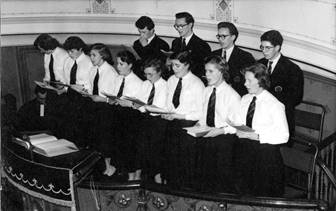
I was while in Yorkshire primarily a singer. I had been a boy soprano at church, in school choirs at Littlemoor, and then again at Aireborough Grammar School. At Aireborough my voice broke very suddenly, from Soprano to Bass within weeks, and while still in the first form I was singing Bass in the school senior choir (the junior choir was 2-part or 3-part treble, so I had to join the seniors!); there I am on the photo, back right. I remember that Mrs Mackay, the music teacher, was amazed that I could change from Soprano to bass so quickly, so young, and she confidently predicted that my voice would go up again and I’d be a tenor in a few years; I’m still waiting! So I was singing bass at school and very soon at church. There were school concerts; one in 1956 included our class (3A) doing the “Jackdaw of Riems”, and another for charity in 1957 included the senior choir. Mrs Mackay left school and was replaced by Miss Wise, and I took a lead part in the school musical (Merrie England) and joined in twice in the Leeds area mass schools choir, where we sang Vaughan Williams (the “Sea Symphony” one year, “Dona Nobis Pacem” another) in Leeds town hall, accompanied by a professional symphony orchestra and the massive five-manual organ … and yes, I did get a chance to play it during a rehearsal interval!
Mrs Hardisty Snr. was of course our main inspiration … among her memorable lines was one to reassure us about nervously facing the congregation to sing (the choir pews were in a balcony facing the congregation, at the front centre of the church) … “I just pretend I’m singing to a field of cabbages”. On one occasion at least she sent us young singers out to concerts – and I remember going with Maureen Clark and Carol Jones into Leeds on the bus to a concert; it was a foggy evening, a pea-souper, and working out which road was which was very difficult, so on a “where are we?” Maureen came out with the totally appropriate reply “I haven’t the foggiest”. We laughed the rest of the way there.
Mrs Mackay taught Rosalie piano, and was an excellent music teacher, doing singing and music appreciation. The other aspect of her musical life was that she did recital and recording accompaniment under her professional name of Eileen Holdsworth, recording for EMI. She co-founded the Aireborough Grammar School Old Scholars Association Gilbert and Sullivan society, known by the delightful initials as AGSOSAGSS; their first production was the “Gondoliers”, my first introduction to G&S, because a few of us lads from school were drafted in to do the non-singing bits – I was the boatman! Stanley and Judy Fawcett, who lived opposite the manse, starred as the Duke and Duchess, and in all the years since I have to rate their performances as second only to the D’Oyly Carte.
However, my singing was gradually reducing and my playing increasing. Eventually I accompanied the school choir for Speech Day, rather than singing in it. At church, I was playing occasionally for services and one year Margaret Hardisty stepped aside and I played for “The Crucifixion” (the choir alternated between that and “Olivet to Calvary” for Easter cantatas)[46]. I played for all Scout and Guide parade services, including the district St George’s Day parades. I also played for the “Men’s Efforts” (q.v.), and egged on by John Brookes[47] played quite a lot of pop music at home. And I played for my first funeral – Maureen Clark’s, after her tragic road accident[48]. At school, Mr Frost (French teacher) started lunch-time dancing classes – it was a senior school tradition to hold Christmas dances – and here we learned ballroom dancing, and some of the party dances such as Barn Dance, Gay Gordons and Veleta. We used the school record-player for these, but when people wanted to dance rock-and-roll there were no records; so I played the piano, playing from memory the pieces I had heard on the radio (few people had record players at this time, hence few records). As the various church YPF groups put on their social dances the same thing happened, until gradually records took over.
I did buy a bit of sheet music. The place to go was Banks’ music shop, in the Central Arcade in Leeds; it was a massive jumble of music, ranging from the classical to the pop; there I picked up a few piano transcriptions (e.g. the 1812 overture, arranged for piano trio!), some albums of old-time songs, a few pop sheet music (in those days sheet music was still published for pop songs) and of course organ music. Opposite the shop was a “Palais de Dance”, and there the first DJ appeared – one Jimmy Savile; I remember him chatting to passers-by outside the music shop. Then one time at a YPF dance at Benton Congregational Church, in the middle of the evening he came in with records etc as spot prizes; the girls thought it wonderful. Later of course he became famous nationally on TV, as a DJ and later as the presenter of “Jim’ll fix it”[49].
Link forward to next chronological or next on this subject : link backwards to previous chronological, to the Introduction, or to family documents index.
[43] She had a fine soprano voice, which had been professionally trained.
[44] A resonant Trumpet-like sound
[45] She had lessons from Mrs Mackay (the music teacher at Aireborough).
[46] It was the custom to have a vote of thanks at the end, for the guest soloists – that year Roy Jones gave it and referred to the “youthful organist”; from a former Sunday-school teacher, he paid me a gracious compliment.
[47] John was one of our “lodgers” and was studying Electronic Engineering at Leeds University; see my father’s autobiography.
[48] John Brookes (our lodger) and Maureen Clark became friends, and died together in a road accident while travelling on her first visit to his parents. I played for her funeral (August 7th 1959; my first such service) – I could not bear to play conventional music for the voluntaries, so improvised music “just for her”. John’s parents kindly added Maureen’s name to John’s gravestone in Bures, Suffolk.
[49] He has of course subsequently been revealed to have been a paedophile, but at the time there was no hint of that.