3.5
Music
Having had
the brief involvement with Gilbert and Sullivan in Aireborough, I was delighted
to find that the College at Portsmouth boasted a G&S Society; I’d decided to
join one or at most two clubs, so as not to prejudice the Maths course “too
much”. Rehearsals for the “Gondoliers” (which of course I vaguely knew) were
just starting, so I turned up on the first evening intending to be a bass in
the chorus. Half-way through that first rehearsal, the pianist had to leave,
and the musical director asked if anyone could play “just for this evening”;
the rest, as they say, is history, and I never got to sing G&S, ever, but
became their accompanist for 4 years. The society was open to staff and
students alike (perhaps the only time staff and students really socialised
together?), the producer (Mr Farmer) was the college Registrar … leading to
numerous quotes from the Mikado, “I am the Registrar” … and the conductor
(Sidney Sivyer) a Salvation Army brass band person; I
had a few problems sometimes with the strictness of his tempi, but he knew his
music and I learned a lot from him. The solo parts were shared between staff
and students (and a few ex-students still in the area), and Mr Sivyer gleaned an orchestra from his many musical contacts.
After the Gondoliers came “Patience” and “Ruddigore”, and for those two we had a new young tenor among the student soloists called John Webley, who had done a bit of amateur singing but whom we introduced to G&S; he later joined the D’Oyly Carte company in the chorus, and rose to a principal before his untimely death from cancer (I recently found a tribute to him on a G&S website[68]). Apart from the main performances, we also put on a few concerts, pulling out songs from several of the G&S shows. It was an excellent education in accompaniment, and I stayed with the society for 4 years; after I had left and was in Romsey, I was occasionally poached back, notably to play for the sister college at Cosham, doing “HMS Pinafore”, for which the conductor had arranged a “cheeky” arrangement for two pianos.
The other college musical thing was the Jazz club; basically, there wasn’t one, so we started one! We being a quartet of maths students, 2 in my year and two in the next year below. The first job was to find premises, so we had to tour the area to find somewhere to meet; then hire a band or three, next organise the event, and hope that we made enough to cover costs. In between doing all this, I was co-opted into a traditional jazz band, and later a “modern jazz” quartet (of 6 players!), but these were brief alliances and course college pressures kept me doing maths (from time to time). But the influence was good – and the college managed to attract bands such as Ken Collier, Kenny Ball and Acker Bilk. It was concerts at the Portsmouth Guildhall, however, that introduced me to the jazz of Dave Brubeck and George Shearing.
I was living in “digs”, and there was not always much chance to play, so I bought a “Univox” at a junk shop; this was a short 2-octave keyboard that mounted under a piano and played through an amplifier (it was the solo instrument featured on a Del Shannon record called “Runaway”). But snatching the chance to play the college grand piano at lunchtimes (as accompanist to the G&S I claimed privileges), I started getting “in” to concertos, and bought several piano concertos arranged for two pianos; the first one I copied by hand onto manuscript paper from an orchestral score borrowed from the public library, but that was a lot of work, and I was managing to live within budget. Soon, I could play “most” of these, with “most” of the music from memory; unfortunately, after I started “real work” I never found the time to keep this level of performance up, but it was a triumph at that stage of my life.
Of course, while at Portsmouth I was “in transit”, living
half the year at Coleford; I would occasionally take a hand at the Coleford
organ, and accompany the choir or a soloist. I also discovered a friend in the
town called David Janes, a pianist, and as the Coleford Baptist church had an
organ and a grand piano, he and I tried to do the Beethoven piano concertos,
with me on the organ pretending to be an orchestra! Unfortunately, the two
instruments were too far apart physically and visually for it to be a great 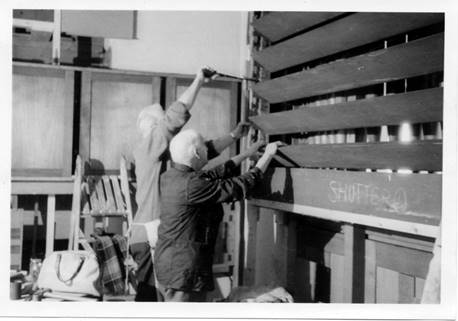 success.
Once I had found the church at Devonshire Avenue, they soon put me to use, with the young people and as reserve organist during term-time. After a year or so, they decided to replace their organ, and discovered an old Compton pipe-organ in a local cinema, and as I had time to spare at that moment I spent a lot of time preparing it to be dismantled for removal; the deal was that all the “effects” (bells, whistles, drums, car-horn etc.) were to go to a cinema organ specialist, and the church would take the basic pipe organ (the picture shows the swell shutters being assembled back in the church). I was astounded at the workmanship; the organ was in a room behind the screen, that no one but the tuner would ever enter (the console was down at the front of the cinema – one that would rise up from the floor), and it was covered with dust, but under the dust was polished woodwork and trunking in mint condition, with even the framework in A1 quality.
But the main musical highlights of my student days were musicals (G&S with the D’Oyly Carte on tour[69], and other musicals by local amateurs[70]) at the King’s theatre, Southsea; price 1/6d in the gods. And the more expensive concerts at the Guildhall, right next to the college; I went to a few orchestral concerts, but the innovation for me was going to see George Shearing and Dave Brubeck jazz concerts – we had had “trad jazz” as a part of Student life, with Ken Collyer, Acker Bilk, Kenny Ball et al coming to the Student balls, but this was “modern” jazz, and an eye-opener to me, because all I had heard on the radio up till then had been largely discordant and unapproachable. Later, I bought a Brubeck double-LP album, to re-hear his music again and again.
Mr Sivyer roped me in to accompany him on a number of his projects; he conducted a Ladies choir in Gosport (under the auspices of “evening classes”), so I put my scooter on the old Gosport ferry (passengers and cycles only) and crossed the harbour, played for them, and did the return journey, and earned a few shillings a night – welcome for a poor student. Unfortunately some of the choir ladies tried to “mother me” a bit, but there were a couple of attractive young ladies in the choir, which compensated.
Link forward to next chronological or next on
this subject : link backwards to previous
chronological or previous on this subject, to
the Introduction, or to family
documents index.
[68] The website is WHO WAS WHO IN THE D'OYLY CARTE OPERA COMPANY
[69] I had programmes for Sept 1963 (Gondoliers, Iolanthe, Mikado, Trial+Pinafore; Pinafore when played at Southsea always drew applause for the scenery, which was a wonderfully accurate representation of the Portsmouth skyline), Sept 1964 (Yeomen, Patience, Ruddigore, Iolanthe, Trial+Pinafore); the cast list included John Reed, Donald Adams, Thomas Round, Kenneth Sandford, Gillian Knight, Mary Sansom, Jeffrey Skitch, Pauline Wales, Alan Styler, David Palmer, Ann Hood, Anthony Raffell, Peggy Ann Jones, Valerie Masterson, Philip Potter. Also seen at the Kings Theatre – the Boy Friend (amateur), The Student Prince (John Hanson tour), Madam Butterfly and Peter Grimes (Sadlers Wells) and even the Royal Ballet!
[70] Two of the College G&S people were also members of the Portsmouth Players, one of these amateur groups.