3.4
Work and
computing
Maths Degree
My degree was a conventional Maths honours course[63], featuring pure maths and applied maths subjects; the former suited me better, but the latter included Relativity, which fascinated me. Among the “pure” subjects was “Algebraic Projective Geometry”, which according to Dr Philip Haskell (a short, round blob of a man, with a fascinating sing-song voice and a great sense of humour[1]) was useless, except to keep him in a job … “you can’t build bridges with it, you can’t make bombs with it, it’s no use for anything”, he said, “except that it keeps me in a job”. He’d tell us about 256-dimensional space, and when asked if there were 256 dimensions, said “I don’t know and I don’t really care – but IF there are, this is what the mathematics would be like … and if one day some fool discovers that there ARE 256 dimensions, we’ll have the mathematics ready for them!”.
I have already described studying theories and maths relating to quantum theory; the other “applied maths” subject that interested me enormously was relativity. Even today, I am amazed at the thought processes that allowed Einstein to formulate special and general relativity – and the confidence that led him to assert them when “common sense” said that they could not be true.
In the year after graduating, there was the London University graduation ceremony at the Albert Hall. My parents came to London for the occasion[64], and as we walked up to the hall we saw people we knew; Arthur Winfield and Philip Beadle, and their parents. We had all been to Littlemoor School, Arthur and I both went to Aireborough (Philip went to Woodhouse Grove). And there we all were together in London. In the hall, the Chancellor (the Queen Mother) received the Doctorates first, then the Masters, then the Bachelors last. We went forward in alphabetical order within faculty, walked to mid-platform, and as our names were read out turned and bowed, then walked off. The Queen Mother, of course, gave us each a smile and an inclination of the head – as though she’d been looking forward for the last year to meeting me – this was of course much of her “magic”.
Post-Graduate work
and the 803
Plan A after graduation was to become a Maths teacher; I had a place at Bristol University to do a 1-year teacher training course, and they suggested that it would be a good idea to visit a school and see what it was like being a non-pupil. I arranged to visit Rosalie’s school at Coleford, and did a bit of observing and a bit of teaching for the last 2 weeks of term. That fortnight convinced me that I’d thoroughly enjoy teaching – provided the pupils were in the top stream and wanted to learn; it convinced me that I would NOT enjoy trying to teach those who couldn’t or didn’t want to learn. So Plan A was abandoned, and I went back to College at Portsmouth.
I spent a year (1964-65) after graduating, working with a mild-mannered lecturer called Mr Venables on the algebra of “certain quantum particles”; the fact that I knew almost nothing about quantum physics and atomic theory he dismissed as irrelevant, and we were really just trying to understand the maths of some formulae that physicists were finding useful. Halfway through the year, the college took delivery of its first computer, an Elliott 803b 5-hole[65] paper-tape machine, which was installed on the top floor – it took up most of the floor - of an office block. Mr Venables thought that a computer should be able to help us with our work (what I now know shrieks out how impractical this was, with the software tools available at that time … i.e. none at all), so I went to find out how it worked and what it would do. And I was hooked!
 This is how it worked – so you know what
we had to do in these early days of computing.
This is how it worked – so you know what
we had to do in these early days of computing.
- You
edited the programs [I know the word is “programme” in English, but the
computer industry has always used “American” … it has also always used TLA’s
wherever possible, and in case you didn’t know “TLA” is a TLA for “Three
Letter Acronym”!], written in Elliott 803 autocode,
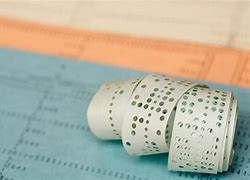
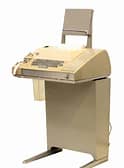
directly onto paper-tape, using an ASR33 teletype (pictured right). Each
character (letter or digit) became a row of holes punched across the tape
(see picture; we used 5-hole tape, so capital letters only … later came
8-hole tape which could take lower case letters and punctuation). To
change a program, you fed the old tape through the teletype (I think it
worked at about 10 characters per second) till you got to the place you
wanted to change, typed the new code, moved the old tape forward, then
started copying again[66].
Large bins contained the paper tapes.
- Then
you wound the tape into a spool; this involved a hand-winder and a series
of metal loops hanging from the ceiling, through which the tapes were
looped.
- Load
into the computer the paper-tape for the “first-pass compiler”, wind it up
again, and hold it in a roll using a rubber band.
- Load
your program; this produced an intermediate (assembler code) tape; wind
both of these again.
- Load
the “second pass compiler” and wind it up again.
- Load
the intermediate tape; this produced a final machine code tape; wind both
up again.
- Load
the final tape and run the program, and wind it up again.
- If
the program generated output, it came out as a tape – wind it up, take it
to the teletype to print it, then wind it up
again.
As you can tell, progress was slow. If you were lucky, a program error would be detected by the first-pass compiler – but often it wasn’t until the 2nd pass that you found out there was a spelling error in the program. But programs were very small in those days too. For the more complicated programs, algorithms were published in the technical journals – people in the USA/UK competed with each other to find quicker/faster/“neater” ways of solving problems, and others “certified” previously published algorithms (i.e. stated that they had used them and that they worked correctly). So a program would be a custom-written part with a few published algorithms[67]. There were no magnetic devices – no disks or mag tapes; paper tape and printed paper was all we had. And of course, paper tape tangled and tore …it could be repaired by sticking a self-adhesive metal strip over the tape, then re-punching the holes manually using a hole punch (this could also be used as a sometimes quicker way to fix errors)!
I tried to get some results that would keep Mr Venables happy – to the point where I could print out graph shapes on teletype paper. I don’t think I succeeded, though some of the outputs he described as “interesting” (which could mean “revolutionary”, or simply that he didn’t believe them at all). But it was my introduction to computing.
The other part of my job at college was to do some teaching, mainly at the local technical college at Highbury, to A-level students.
Link forward to next chronological or next on
this subject : link backwards to previous
chronological or previous on this subject, to
the Introduction, or to family
documents index.
[63] I was to take and pass the London University external degree; equivalent to an internal degree, we had the added handicap of not getting exam hints from our lecturers, so we reckoned it was really worth more!
[64] They eventually attended this ceremony for each of their three children, and saved the three programmes.
[65] Later technology used 8-hole tape (wider); the main difference was that 5-hole tape was all upper-case, where 8-hole could accommodate lower-case and upper-case letters.
[66] There was an alternative editing method, for minor changes – you could stick a slightly metallic “label” over the paper tape and then re-punch the holes using a hand punch, looking up the hole combinations for each letter of the alphabet.
[67] In those pioneering days, computer programming labour was cheap but hardware was expensive and memory very limited; so the aim of computer programming was to produce the smallest program possible. These days, the relative costs are totally reversed, so the aim is to produce a working program as quickly as possible – if it needs more memory, just buy more!