2.6
Other hobbies
Scouting
With my mother having been in the guide movement at Soham, she very soon got involved at Rawdon, and started or resurrected guides and brownies at both Rawdon and Guiseley churches. When I was still quite little, I was taken on a guide camp, and was looked after sometimes by mother, more often by the older guides. So it was natural that I would be slotted into a Cub Pack at age 7 or 8.
The Scout Group was the 16th Airedale, based at Queen Street Methodist Church in Yeadon, so to get there meant a short bus ride (the Sammy Ledgard single-decker from Henshaw Lane). The leaders were Mr and Mrs Reed (he being known in Scouting as “Tawny”, she as “Akela”). I did well in cubs, enrolled in Nov 1951, first star May 52, second star Aug 52, and Leaping Wolf[50] badge Nov 52, collecting 5 proficiency badges on the way. We had an annual cub camp in Helmsley, transported in Prince’s lorry to a farm at the top of the main street – with a stream along the field in which we washed! I remember the glee with which we withdrew our pocket money from “camp bank” (1/- or even 6d at a time!) and went into the town to inspect the sweet shops. An annual highlight of Cub life was the Bob-a-Job week, when I would do a tour of Church folk doing garden or kitchen jobs for them, for 3d or 6d for scout funds. The other annual feature in the 16th was the concert, given for Queen Street church folk, parents and friends, and featuring leaders, scouts and cubs (and the guides and brownies joined in for the finale); I still have a sketch “A Ghostly Good Turn” that I think I was in while in scouts there.
I moved up to the 16th Scouts on 5th March 1954, and gradually passed the second and first class tests, got the usual armful of proficiency badges[51], and then went on (in Senior Scouts) to get my Queen’s Scout badge[52]. Among the scouts there were my friend Donald Brown from Rawdon (with whom I shared my “first class hike”, and who was partly responsible for my cut wrist!), and Peter Tunstall (Katie’s cousin) from Yeadon. The Scouts camped further afield; at least twice we went to Grange in Borrowdale (the bottom end of Derwent Water in the Lake District, and reputedly the wettest place in England) … where else did we camp?? In addition, we met in Summer-time in Carlton woods, doing fire-lighting, building bivouacs (we pronounced them “bivvies” – how could I not include as wonderful a word as bivouac in this document!) and similar activities out of doors. I was of course cycling to Scouts at this stage. The camp-fire songs used by the Scouts differed somewhat from the gentler ones used by the Guides; in addition to the standard ones used by most Scout groups, the 16th had their own group song (tune: Blaze Away) which we sang at concerts, camp-fires and travelling to and from camps – especially loudly when passing other scouts or going through towns! I’m going to try and remember the words, after some 45 years have passed;-
Chorus (all)
We are the 16th Airedale Scout group, and we think that life is grand,
We put the “out” in all our scouting, and we thing that we’re the best group in the land;
When camping out we are so happy, and the hikes are such a joy,
So come on 16th Airedale, and you’ll cubs and scouts (shouted) “Yahoy”.
Interlude (sung by seniors and leaders)
Passing the summer on numerous hikes (all repeat)
Whether the weather be wet or be fair (all repeat)
We
don’t mind as long as we’re there.
We don’t mind
the rain but we’d rather have the sun…
Chorus again.
In 1957 there was the Jubilee Jamboree at Sutton Coldfield, marking the Centenary of BP’s birth and the Jubilee of his death (1857-1907 … how much he achieved in 50 years). I didn’t go to camp, but did visit it for one day – an Italian scout, Ernesto Grube, came to stay with us for a while before the Jamboree, and then went to the camp. I have a set of 8 souvenir stamps from this event.
By the time I was in the 6th form at Aireborough, a Scout Troop had been started at the Cragg, with Stanley Fawcett and Geoff Waite in charge, and Arthur Hardisty as Group Leader. The Fawcett family lived opposite us, in Lime Grove; Judy was one of Mum’s guides, and Susan was I think a year or two younger than myself; Stanley and Judy went on to star as the Duke and Duchess of Plaza-Toro in the AGS Old Scholar’s first Gilbert and Sullivan production of “The Gondoliers”, to my mother’s great enjoyment. Stanley then married the AGS School Secretary, Valerie Pemberton. It was from them that we had “Tess”, a puppy the Fawcett’s dog had produced; this was at the time of the next show, “The Mikado”, and they had named the puppy Katisha after Judy’s part – but we felt that “Tess” was shorter, not too far away from “Tish”, and easier to shout in a hurry!
Anyway, having got within an ace
of having the Queen’s Scout badge (which I completed at the Cragg), there was
nothing more for me at 16th Airedale, and I was asked to go to the
Cragg and help out as “Troop Leader” (being not old enough to be a leader and
too old to be one of the lads); so the last couple of years before college were
spent in this way. I particularly appreciated how Stan and Geoff treated me;
when we went out together for weekend, campsite hunting, it was like three
friends. We set off on our bikes and cycled into the Dales, trying a few
farmers (this was of course before most people, let alone 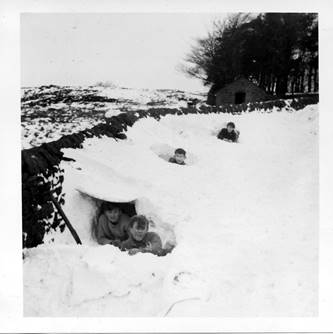 remote
farms, had telephones), and would stop at a farm and ask – do you, or any of
your neighbours, take Scout camps? Usually, one weekend of hunting would find a
good site – access to water, and flattish well-drained ground being the main
requisites, but permission to cut wood etc desirable.
On one site-hunting trip we “camped” (we had come with MINIMAL equipment) in
the top of a barn, lying on top of the straw bales and with the cows below us –
I was amazed how much heat they generate! We had a lodger with us[53], in the shape of a barn owl; I say
“shape” because that’s about all we really saw of it, but it prompted Geoff to
start a series of stories about ghostly white shapes floating eerily among
barns he (Geoff) had camped in, and kept Stan and I laughing for a long time.
Geoff had a fund of tall stories; at the time, he was studying law at Leeds
University, so we got him to call in at the Leeds Scout Shop and get us
supplies; one day he was carrying 6 scout staves in the bus back to Rawdon, and
a friend got on and asked what they were, so Geoff told him they were
solicitor’s poles, used for estimating the depreciation on property, and this
friend took it all very seriously, especially when Geoff told him that if he
went to a certain street in Leeds (noted for legal firms) he would see lots of
them in their suits dragging these poles around with them. How we chortled!
remote
farms, had telephones), and would stop at a farm and ask – do you, or any of
your neighbours, take Scout camps? Usually, one weekend of hunting would find a
good site – access to water, and flattish well-drained ground being the main
requisites, but permission to cut wood etc desirable.
On one site-hunting trip we “camped” (we had come with MINIMAL equipment) in
the top of a barn, lying on top of the straw bales and with the cows below us –
I was amazed how much heat they generate! We had a lodger with us[53], in the shape of a barn owl; I say
“shape” because that’s about all we really saw of it, but it prompted Geoff to
start a series of stories about ghostly white shapes floating eerily among
barns he (Geoff) had camped in, and kept Stan and I laughing for a long time.
Geoff had a fund of tall stories; at the time, he was studying law at Leeds
University, so we got him to call in at the Leeds Scout Shop and get us
supplies; one day he was carrying 6 scout staves in the bus back to Rawdon, and
a friend got on and asked what they were, so Geoff told him they were
solicitor’s poles, used for estimating the depreciation on property, and this
friend took it all very seriously, especially when Geoff told him that if he
went to a certain street in Leeds (noted for legal firms) he would see lots of
them in their suits dragging these poles around with them. How we chortled!
One of the highlights of scouting at the Cragg was the year we did a winter camp; I cannot remember where it was, possibly in the Pateley Bridge area, but we camped in a wooden cabin, played ice hockey on a frozen pond, and made igloos in a massive snow-drift – there are photos in the album of this camp (see left).
Cycling
My father was the “original cyclist” – I have said that when on his own, that is how he travelled around Rawdon and Guiseley doing his church work; certainly it kept him fit and healthy. When we travelled with him, we’d use the bus to get to Guiseley, walking to Henshaw to catch it and then from the Station hotel at Guiseley to the church in Oxford Road.
In Wollaston, I rode with him sitting (on a small saddle attached to his crossbar) between his arms and legs. I think I later had a child’s bike, and learned to ride in the back paddock at Rawdon, and I think a black larger one during Littlemoor days. On passing the 11+ exam, I was given a brand new (I think; if not, reconditioned) red Raleigh bike, bought from a cycle shop next to Craven’s electrical shop, by the Station Hotel at Guiseley; on this I rode to and from school during all my Aireborough days - I was the envy of many other boys in the early years, partly due to the bike’s quality and partly the red colour! In those days, the schools with the police organised “cycling proficiency tests” (which I passed easily), and once or twice, bike inspections – which leads to a story. For one inspection, Nigel Clarke (who lodged with us before John Brookes, and had a somewhat un-roadworthy bike) left a note for the policeman … something along these lines;
I don’t need a bell, ‘cos I’ve a loud voice
I don’t need brakes, as my legs are long enough to reach the ground each side
Etc. Etc.
My bike was also my “escape” in holidays and Saturdays, as to do a cycle ride into the Dales was an approved pastime; I would cover 20-40 miles on a spin, which in that country is more than it seems – many times, I would ride down a Dale in about 2 minutes, then spend 15 minutes cycling/pushing up the other side! Cycling was part of Scouting, schooling, and much else. I cycled to Horsforth and back for organ lessons, and to Kirkstall later for services and practices as “organist”.
Model Railway
What can I say? – like so many, I
started with a Hornby clockwork train using the old metal track, which was
usually set up in the playroom, but in the 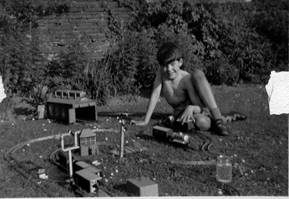 summer
could move onto the lawn where there was more space (see photo). Later I
graduated to a “Dublo” 00 gauge electric train sets.
Additions to the basic set came as birthday and Christmas presents, and from
saving up pocket money. Eventually Mum and Dad arranged for someone to make up
a railway table, about 6’ by 8’ with a 3’ by 2’ hole in the middle for me; this
was set up resting on “scrounged” orange boxes in the playroom, as a more-or-less
permanent feature, and I was able to develop the layouts and do some scenery.
Katie remembers vividly visiting the Manse to play with Rosalie and being
fascinated by this, but told by Rosalie not to even touch it “or Bernard will
kill you”[54].
Must be a trick of her memory! Anyway, I joined the Hornby Railway Company
(owners club) in December 52, and received a handsome certificate of election to
membership and a lapel badge! Sadly, neither of our boys really enthused on
this subject, though Adrian had a small layout[55].
summer
could move onto the lawn where there was more space (see photo). Later I
graduated to a “Dublo” 00 gauge electric train sets.
Additions to the basic set came as birthday and Christmas presents, and from
saving up pocket money. Eventually Mum and Dad arranged for someone to make up
a railway table, about 6’ by 8’ with a 3’ by 2’ hole in the middle for me; this
was set up resting on “scrounged” orange boxes in the playroom, as a more-or-less
permanent feature, and I was able to develop the layouts and do some scenery.
Katie remembers vividly visiting the Manse to play with Rosalie and being
fascinated by this, but told by Rosalie not to even touch it “or Bernard will
kill you”[54].
Must be a trick of her memory! Anyway, I joined the Hornby Railway Company
(owners club) in December 52, and received a handsome certificate of election to
membership and a lapel badge! Sadly, neither of our boys really enthused on
this subject, though Adrian had a small layout[55].
Link forward to next chronological or next on this subject : link backwards to previous chronological or previous on this subject, to the Introduction, or to family documents index.
[50] The highest award for cubs, awarded for 2nd star and two proficiency badges.
[51] Having now found the certificates that my mother had kept for me(!), I can note Firefighter, Music Maker, Messenger, Linguist (the examiner was Mrs Sutcliffe, who taught us French in the 1st form at Aireborough), Speaker, Stamp Collector; then in the Senior Scouts Ambulance, Fireman, Interpreter, Despatch Rider, Pioneer, Meteorologist and Venturer; the collective award of the Bushman’s Thong came first – this came as a piece of leather cord, which you had to knot into the correct form to wear on your uniform – fortunately, instructions were provided.
[52] The custom was that, once the Queens Scout badge was obtained, all other proficiency badges were removed – leading to anecdotes of people catching severe colds because their shirts were so much thinner!
[53] Perhaps it regarded itself as the rightful occupant, and we as lodgers?
[54] Not true … had she touched it, I’d probably have “killed” Rosalie!!!!
[55] Our second grandson Matthew may redress this lamentable deficiency – his other grandad Eddie Orme possesses a large railway layout.