2.3
Christianity and
the Church
There were some benefits to being the child of a minister who had two churches. Although my Mother and we children went to the Rawdon church most of the time, for continuity and closeness, we were “honorary members” as it were of the Guiseley Sunday School as well – so we got to go on two Sunday School outings in the summer, and two Christmas parties in the winter. We all went to Guiseley for special services, too – harvest festivals, baptismal services and Anniversaries.
I should perhaps explain the arrangements, for anyone who has not read my father’s autobiography; he would normally take a morning service at Rawdon and an evening at Guiseley, and then the next week swap the two round. The “other” church would be served by a student, or occasionally a member of staff[16], from Rawdon Baptist College[17]. When my father went to Guiseley, he would normally cycle (or take the bus in the worst weather), and we walked to Rawdon; when he was at Rawdon, he usually walked with us (or ahead of us if/when we were a bit late!).
 The
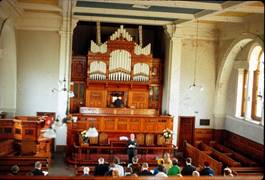
Cragg church at Rawdon was enormous – a “barn of a place”, as they said – with
golden varnished woodwork for pews, choir and organ, pulpit etc. (see photo
taken in 1969 at our wedding). The pulpit was on the left, and the communion
table above the baptistery in the centre, in front of the raised choir stalls
and organ. Behind the church were meeting rooms on two floors, and then the
schoolrooms (on two floors likewise) at 90 degrees, each hall having a platform
and curtains. A caretaker’s flat was built into the building, and in the area
formed by the L-shaped buildings was a graveyard, the site of the original
church, with a sundial marking where the pulpit had been. It was an ideal
building for young lads, due to the enormous number of hiding-places! One
rather “spooky” place to explore was a corridor between the primary room and
the ministers vestry – the organ blower and bellows was on one side, and on the
other would hang my father’s baptismal outfit, with built-in wellington boots …
looking like a hanged man in the dark!
The
Cragg church at Rawdon was enormous – a “barn of a place”, as they said – with
golden varnished woodwork for pews, choir and organ, pulpit etc. (see photo
taken in 1969 at our wedding). The pulpit was on the left, and the communion
table above the baptistery in the centre, in front of the raised choir stalls
and organ. Behind the church were meeting rooms on two floors, and then the
schoolrooms (on two floors likewise) at 90 degrees, each hall having a platform
and curtains. A caretaker’s flat was built into the building, and in the area
formed by the L-shaped buildings was a graveyard, the site of the original
church, with a sundial marking where the pulpit had been. It was an ideal
building for young lads, due to the enormous number of hiding-places! One
rather “spooky” place to explore was a corridor between the primary room and
the ministers vestry – the organ blower and bellows was on one side, and on the
other would hang my father’s baptismal outfit, with built-in wellington boots …
looking like a hanged man in the dark!
I suppose I must have started in the primary Sunday school, and I seem to remember Margaret Barmby[18] teaching me; she later became a regular baby-sitter at the Manse for my sisters. But then I moved into the main Sunday School; we met in the afternoon (after having attended morning service earlier), had a time of worship, notices and offering (one old penny, typically, from my 1 shilling per week pocket money … the pocket-money formula was 1d per week for each year of our age, but I strongly suspect that inflation benefited my sisters later!). Then we went into our (age-based, single-sex) classes for a while, finally coming together again for a closing session. We changed teachers every year or two, and most of them did well for us, keeping us reasonably interested; the one I remember with greatest esteem was Roy Jones[19] (father of Carol[20], one of my YPF friends), who impressed us as a “man’s man” yet with a sure Christian faith. We sang hymns from the “Sunday School Hymnal”, now I think unobtainable; the one most engrained in my memory was “Carest Thou not that we perish” (more usually known as “Master, the tempest is raging”, with the chorus “The winds and the waves will obey My will, peace be still”) – details not exact, but this gives you an idea of the sort of songs we used.
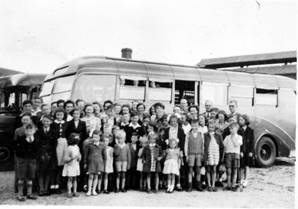
I have mentioned the Sunday school outings; the Rawdon outing normally went to the East coast (Filey, Whitby, Bridlington etc) and the Guiseley one to the West Coast (Morecambe or the Lakes)[21]; we would all pile into coaches, the lads making for the back seats, and the parents and younger children at the front. There would be a comfort stop halfway, and we would be delivered by prior arrangement to a Baptist church at our destination – this would provide wet-weather accommodation, and cups of tea to accompany our “packed lunches” (one cardboard box each, containing sandwiches and a cake or two). Then we would be free to set off to the beach or whatever, either as family groups or (as we grew older) in groups of our peers. We met back at the church at a certain time for the coach ride home, with community singing (of the “Ten green bottles” variety) on the way home. To young people today, this may seem terribly tame, but to us these outings were real treats[22]. On one such outing, to Whitby, I fell on some cliffs, and severely grazed my right thigh – the scars are still there. One memory that lingers is the outing when I was about 12 or 13; one of the young girls had been teased and tormented by some lads in her age-group, and wanted to escape, so she came and sat on my knee all way home – that was Katie[23]!
I must also mention an early Christmas party, at Guiseley; I must have been under 6 at the time – they had arranged for a local conjuror to come to entertain us children, and of course I was mystified and enthralled. At one stage he put an egg in a bag, got me to sit on it, and then pulled out a cloth chicken! And at the end of the show, he lifted up his top hat, to pull out the proverbial rabbit (which, he said, every conjurer should be able to do); but instead, out popped a yellow teddy bear … of course, the local conjuror was Harry Corbett, and the teddy was “Sooty”, on possibly one of his first ever appearances, and long before he moved to television.
An big event in church life was the Annual “Sale of Work” at Rawdon; the upstairs schoolroom was filled with stalls of various types – a needlework stall, a cake stall, and the men’s stall (selling fruit, soft drinks and crisps – much more to our taste than fancy shortbread!) were the regular stalls, with others changing year-to-year. There was usually a bran tub, and a few “skill” games to try – hoopla, billiards (there was a full-size billiard table in the upper schoolroom) and others. And at the end of the day there would be a concert and a “vote of thanks”. At the sales of work and many other events would be a “church tea”, served with long rows of trestle tables, each presided over by one of the ladies who sat at one end behind an enormous copper urn of tea; down the centre of the table would be plates of sandwiches and cakes … I mention this mainly to explain the family saying “doing a Mrs Winn”, which refers to the habit of that lady saying “you’ve finished with this haven’t you” and taking away of a plate of food before the folk at the table could draw breath to say “well, actually, we haven’t quite finished yet”. In the main, she used this tactic to get more food onto the “lads” table, so I didn’t complain too much (i.e. not at all).
Concerts seem to have been the main entertainment; church members would do their party pieces, and some other people (probably friends or contacts of church members) would come and sing; songs like “The Lost Chord” and “Song of the Vagabond” were the norm. Later, I remember Katie’s sister Maureen Clark and a dancing-class friend doing a skeleton dance (a black costume with skeleton markings, done in low light). But the big concert of the year was the “Men’s Effort”, where the men of the church let their hair down; these events started when I was about 14, and I was roped in to provide piano accompaniment – effect music, and accompaniment to the songs. There was a theme each year[24], and the chief script feature was the end of Act one, which always led to the discovery of buried “treasure” or some such – which was the supper (Cornish pasties, or pork pies and peas) for the audience; cries of “to the woods” were of course mandatory[25]. Despite amateur scripts and amateur performances, this event caused howls of laughter – part, perhaps, at the incongruity of the well-known (and usually fairly serious) men in unusual costumes and situations.
After going to secondary school, we moved up into YPF; and what we did on Sundays was more grown-up. But we were also given a lot of freedom socially, with minimal adult supervision – so we would organise our own walks/hikes, and then the dances (we would decorate the upstairs schoolroom, rig our own sound system – 3 watt speakers seemed quite loud, then!) where we did refreshments and gave spot prizes, and made a modest profit from the admission charges. I think we gave some church members some concern (and probably my father heard comments!), but we were allowed to continue, even when there was a bit of trouble one night[26]. The group of young people stayed together and kept involved in the church during their teenage years, which I guess was the main thing.
But what of my faith? I think that Rawdon laid the foundation for my basic Christian education, and gave me a basic insight of the truth behind the faith. Obviously, I grew up believing Christianity to be real and true, and nothing disturbed that during my school days[27]. Emotionally, I wanted to serve the Lord; I “went forward” at about 13 at a rally at Guiseley, and perhaps my faith was triggered from that time. But I cannot say that I was yet a committed Christian – that came later.
Link forward to next chronological or next on
this subject : link backwards to previous
chronological, to the Introduction, or to family documents
index.
[16] Usually fine, but there was one member of staff whose sermons were, dare we say, more than somewhat dry.
[17] Located in Cragg Wood; it was closed after we left, and merged with the Northern Baptist College in Manchester.
[18] Now Margaret Johnson, living in Morecambe.
[19] He had served in the Army during the second World war, and told us some of his experiences – I cannot recall the details, but do remember being impressed. E R Jones died in October 2002 after a long illness.
[20] Carol later married David Milner, a student at Rawdon College, and became a Baptist Minister’s wife; we visited them in Norfolk in April 2002.
[21] There seemed to be a major dividing line between Rawdon and Guiseley – the focus for family holidays reflected the Sunday School trips, Rawdon families going East and Guiseley ones going West!
[22] It must be remembered that at this time there were very few private cars, and hence we seldom travelled (by public transport) much more than 15 miles radius from home.
[23] Who cannot remember this incident at all!
[24] I recall one on “pirates”, one featuring “Bully Bitlins holiday camp” and so on.
[25] This refers to an occasion when my mother, as Guide Captain, had been reporting to an annual meeting, and in innocence told the assembled gathering that the Guides had undertaken “some interesting activities in Cragg Woods, with the Scouts”; I think it took about 15 minutes or more before the folk were sufficiently calm for the meeting to continue!
[26] Nothing compared to the trouble that can happen nowadays, but in the 1950’s an incident – some non-church youths tried to muscle their way in, to cause trouble.
[27] Despite the “dreadful” school assemblies – see later.