2. Growing
up in Yorkshire
2.1
Basic life-line,
key dates, addresses etc
We stayed at Rawdon for fifteen years, living at the Rawdon (Baptist) Manse in Apperley Lane[11], Nether Yeadon (picture). While there my two sisters were born; Rosalie at home in January 1947, and Marguerite at the “Four Gables” nursing home in Horsforth in May 1952. I left home in September 1961 to go to college, and the rest of the family moved to Coleford in Gloucestershire in November/December of that same year.
2.2
Family Life
Dad has described the house[12] to some extent in his autobiography – it
was huge, compared to the rather cramped house at Wollaston, and the main
attractions (for us children) were the window seats in the two front rooms, set
in the thick stone walls. The 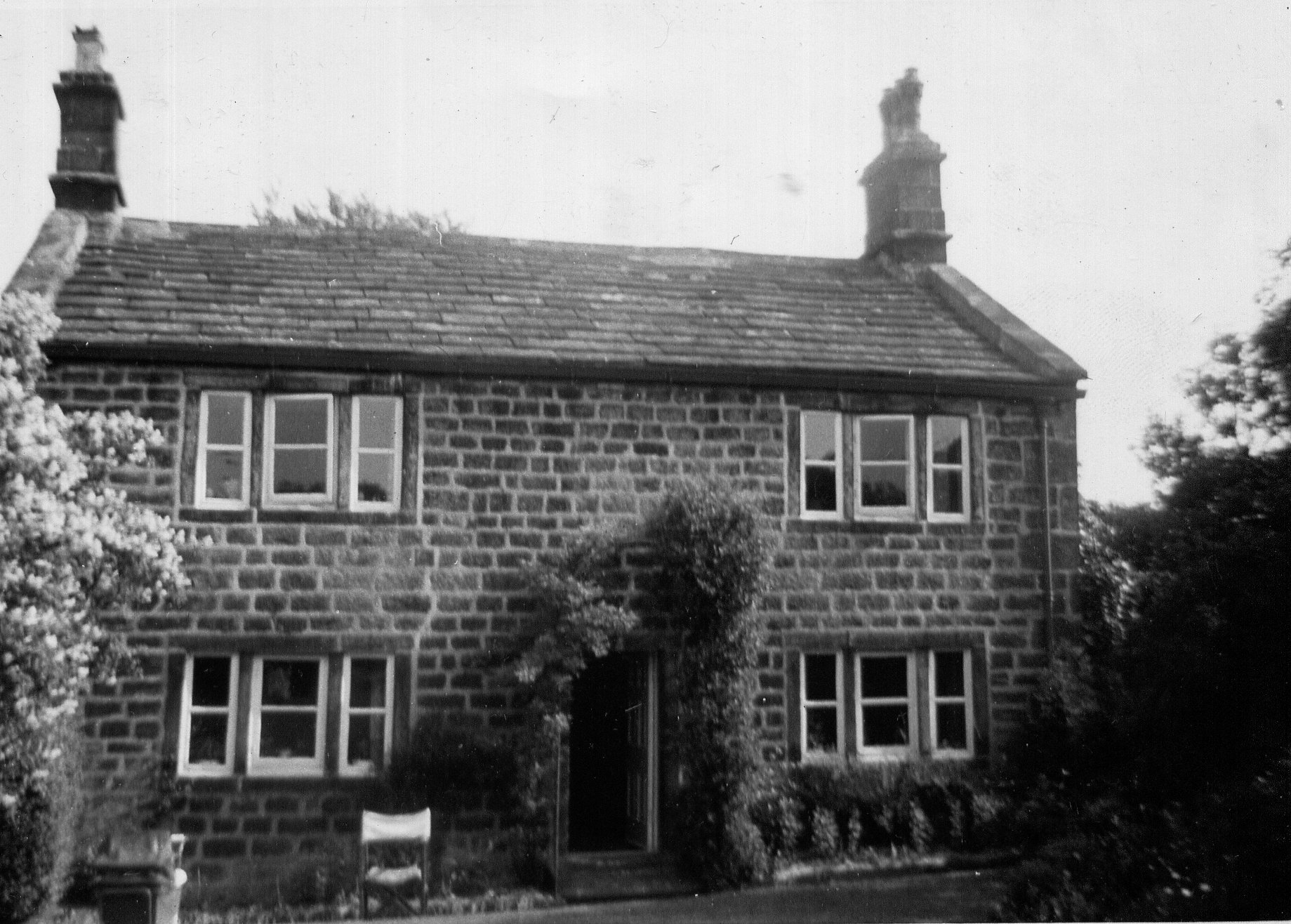 large playroom was
at ground-floor level at one end and first-floor at the far end, as the ground
sloped a bit; and as I grew up I perfected the art of escaping through the far
end window, thus mystifying the family by coming in through the back door
moments after going up to the playroom. The main feature of the playroom was
the view over the valley to Esholt[13],
which was great in the daytime (looking to the moors above Hawksworth) but even
better at dusk when the street and house lights came on. Several times I tried
to paint it – and knowing my pathetic abilities as an artist, that says a lot.
large playroom was
at ground-floor level at one end and first-floor at the far end, as the ground
sloped a bit; and as I grew up I perfected the art of escaping through the far
end window, thus mystifying the family by coming in through the back door
moments after going up to the playroom. The main feature of the playroom was
the view over the valley to Esholt[13],
which was great in the daytime (looking to the moors above Hawksworth) but even
better at dusk when the street and house lights came on. Several times I tried
to paint it – and knowing my pathetic abilities as an artist, that says a lot.
 In the paddock at
the back[14]
were apple trees, a lime tree on which we erected a swing, a horse chestnut, and
lots of beech and sycamore. At times a farmer would borrow the paddock to graze
a horse or donkey (to our mutual benefit – Dad’s garden prospered considerably
at those times), and Mr Fountain (whose wife kept the little shop opposite)
kept a few hives of bees, which gave us an occasional jar of honey and lots of
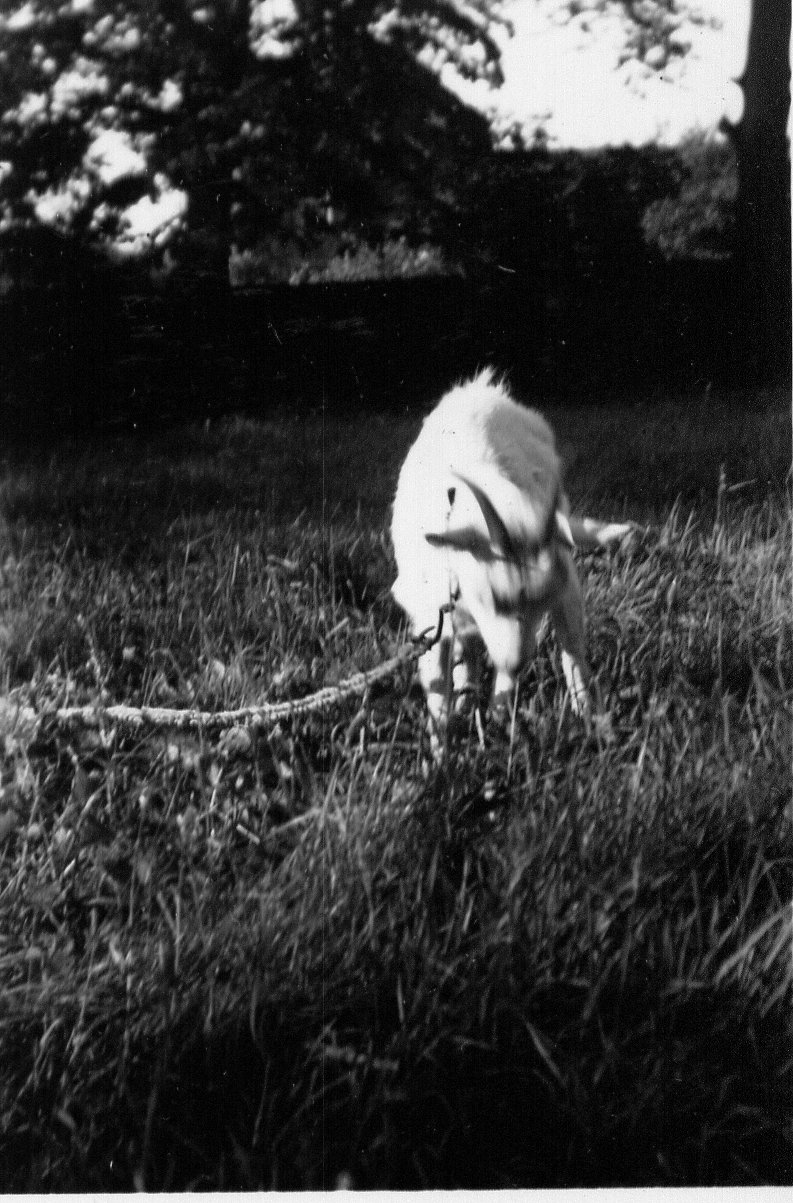
interest at swarming time. Another paddock visitor was a goat – tethered to
crop a circle of grass at a time (picture), it was my great delight to take it
off the tether, especially if there were visitors in the paddock (Mum used the
paddock for Guide tent-erecting and fire-lighting practice, and I took it upon
myself to “help” the Guides overcome any fear of domestic animals!). At the
bottom of the paddock was an old well, almost covered over. And there was a
period when one of the largest beech trees died; we offered it to the 16th
Airedale Senior Scouts for tree-felling practice, and they duly felled it
(which was a social event, and almost a holiday for the family and neighbours).
In the paddock at
the back[14]
were apple trees, a lime tree on which we erected a swing, a horse chestnut, and
lots of beech and sycamore. At times a farmer would borrow the paddock to graze
a horse or donkey (to our mutual benefit – Dad’s garden prospered considerably
at those times), and Mr Fountain (whose wife kept the little shop opposite)
kept a few hives of bees, which gave us an occasional jar of honey and lots of
interest at swarming time. Another paddock visitor was a goat – tethered to
crop a circle of grass at a time (picture), it was my great delight to take it
off the tether, especially if there were visitors in the paddock (Mum used the
paddock for Guide tent-erecting and fire-lighting practice, and I took it upon
myself to “help” the Guides overcome any fear of domestic animals!). At the
bottom of the paddock was an old well, almost covered over. And there was a
period when one of the largest beech trees died; we offered it to the 16th
Airedale Senior Scouts for tree-felling practice, and they duly felled it
(which was a social event, and almost a holiday for the family and neighbours).
The front garden was more formal with a lawn and flowerbeds in front of the house (and an old leaky never-used pond at the top of the lawn), and fruit bushes and a pear tree and vegetable plots to the right. Raspberry canes did well, and we always had enough in the Summer to eat and for jam; one summer when I was about 14 I was left at home for a week, with instructions to pick the raspberries and make jam – and when Mum and Dad returned they were flabbergasted at the amount of jam I had made, with lots of fruit still on the canes. The lawn was used for church garden parties during the earlier part of our stay there.
Inside the house there were rooms to either side of the passage (a study/dining room and a front room), and at the back a breakfast-room and kitchen to the right, and on the left a cloakroom (with enormous store cupboards) that led to the playroom. Ahead was a curving staircase both upstairs to the bedrooms, and downstairs to a stone cellar, where we kept fruit for months on an old stone sink. Heating was by coal fire in the main rooms, with an old cast-iron fire/oven/hob unit in the breakfast room (we have seen these stoves recently in museums!) and an anthracite/coke burner in the playroom; but we also had a gas-fire in the dining room, and one of the winter treats was toasting slices of bread on a toasting-fork in front of the gas fire. There was no such thing as central heating in those days; coal was delivered by horse and cart (later, by lorry), and tipped into the coal-shed (between the house and the street) from there it was taken in metal coal scuttles to whichever room had a fire that day (at most one, unless there was something special going on).
How we lived: Money was very tight – partly the post-war rationing (whenever we bought any food items, we had to hand over money and coupons; the government allocated each family coupons, according to family size); the only “luxury” item in the house was a radio. Most of our clothes in the early years were home-made; the exceptions were cub/scout/brownie/guide uniforms, and school shirts and blazers. Our food was “basics”; cereals meant corn-flakes! To go on bread and butter, or sometimes one-sided toast, there was home-made jam or occasionally bought jam (Robertson’s came with “golliwog” collectibles), marmite, golden syrup or very occasionally honey; when the previous years’ jam ran out we could sprinkle sugar on instead – we held the bread over the sugar-bowl and saw how much stuck to the butter/margarine.
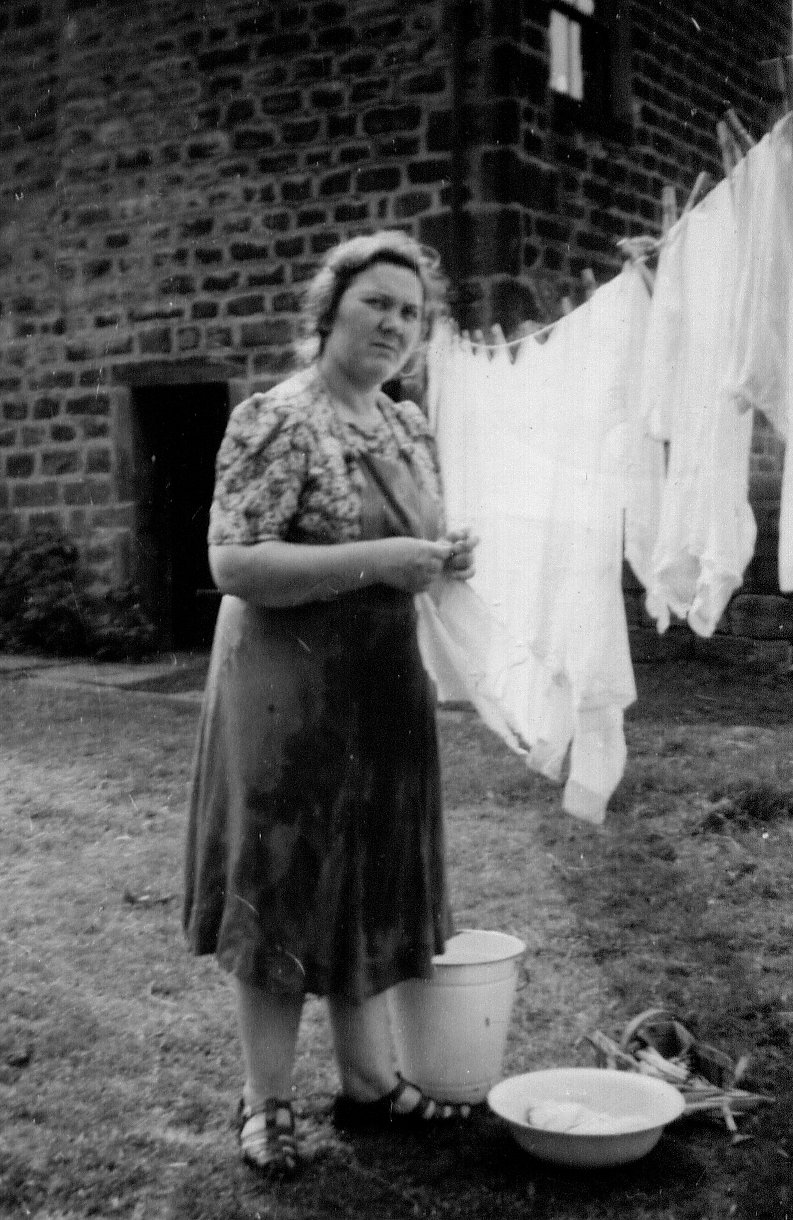
Monday was washing-day … Mum would wear some very old clothes (picture) and spend all day around the copper boiler; as we got older we would be roped in to help operate the mangle (“mind your fingers”) to get the water out of the clothes and back into the boiler. Meals on Monday were usually left-overs, as the washing would take all day. At another time of the week, most of the year, the boiler was used to heat water for us to take up to the bathroom in buckets for a weekly bath, to mix with cold water from the tap; the rule was “just enough water to cover your thighs”; in the winter months the hot water came from the stove in the breakfast room.
Pocket money started when I went to secondary school; the rate was 1d per year of age, so at age 12 I got a shilling a week (5p in current money, but worth much more than that); I suspect the formula was revised upwards when my sisters qualified. I had an account with the “Yorkshire Penny Bank” at Guiseley to keep all this wealth – perhaps as a deterrent from frittering it away; initially this was for birthday and Christmas present money, then it took surplus pocket money (yes, there was a surplus).
Apart from Christmas, we marked family birthdays; we had a (true) saying that my birthday, Christmas Eve, New Year’s Eve (Mum’s birthday) all fell on the same day of the week – so as soon as my birthday happened we could easily work out the day of the week for Christmas. My birthday was marked by a fruit cake … Mum would make a batch of fruit cakes, the main one for Christmas, and one would come out for my birthday as a “taster”.
Holidays: In Yorkshire, most of our holidays were used to visit family; usually going to Soham by train from Leeds Central Station, and usually being hauled by a Gresley A4 Pacific loco (much to my delight!). Some incidents stand in my memory; on one occasion Rosalie and I both went down with German Measles while at Soham, and on another we called in on Auntie Clara, and I saw a TV set for the first time (Muffin the Mule); but the highlight was the summer when I was allowed on the egg-collecting lorry.
John Martin[15] was a member of the Soham Baptist Church, and the manager of the egg-depot, Mr Fowler had been a deacon in Dad’s time as minister, so for a fortnight I went round with John on his rounds – we would collect eggs (one stop, from a little old lady who sold us 6 eggs from her 2 or 3 hens, the next a large farm selling us many crates; John treated them all with equal courtesy), record the number collected, and pay them for the previous collection (cheques for the big producers, or hard cash for the small ones). I helped load the eggs and stack them on the lorry, only once or twice causing any breakages. We even collected a few shell-less eggs! – these were used to make dry powdered egg for catering. At the end of the fortnight I was shown round the factory – grading, stamping (the “lion” stamp), ultra-violet inspection, packing and so on.
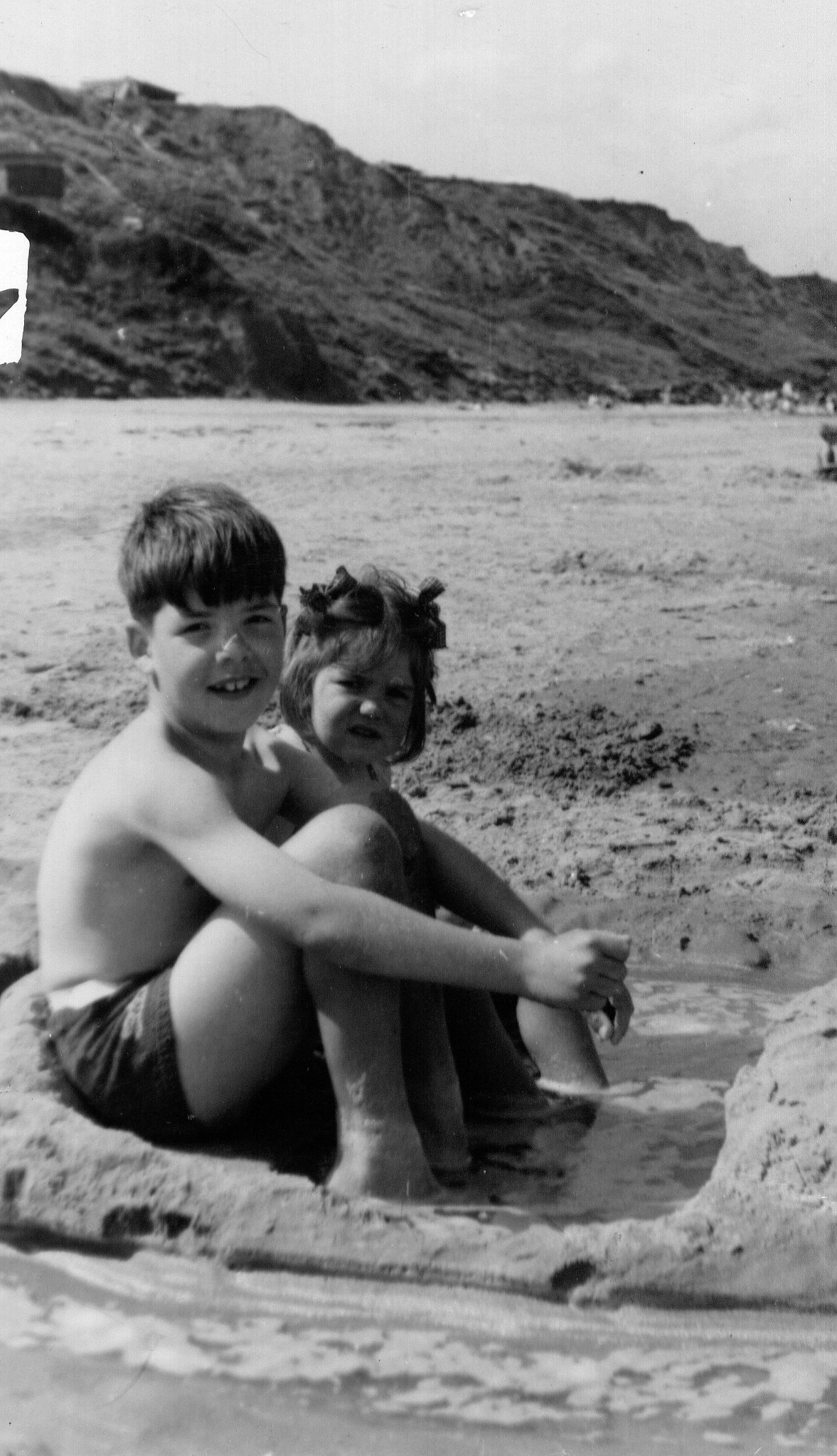
I also remember that one year we had a caravan in the Primrose Valley holiday park at Filey, with its own stretch of beach (picture – Rosalie and I made a sand speedboat and sat in it until the incoming tide started to demolish it). There were visits to my other grandparents at Stony Stratford; my chief memories are of brass bedsteads, the chance to play with Dad’s things (an old all-grey Meccano set, and some architectural stone bricks), lots of snails in the back garden, and the card games of Proverbs and Happy Families, and another game called “Lexicon” that I never really mastered.
However, the main holiday activity was camping. I started camping as “Captains’ son” with the Guides, then on my own with the cubs – not always the happiest of memories – and continued much more happily with Scouts and then as a Senior Scout and leader, right up to leaving for University. The cub camps were all at Helmsley, but the Scouts changed more regularly, with Borrowdale being the site we returned to several times[1]. The campsite at Grange-in-Borrowdale sloped towards the river (in which we washed and from which we took water – not at the same time!), and the scouts’ tents were sideways on up the hill, the leaders and communal areas on the flat ground at the bottom. One night it rained quite a lot, and we Seniors were in a tent at the bottom. We woke up in the middle of the night, and heard one of our number making bubbles – the rain water had come up to his mouth; after an earnest discussion about the pro’s and con’s of disturbing his slumber, we decided we’d better wake him, after which we dug a trench and dried off; the younger scouts, being on a slope, were OK. Later on, as a co-leader at the Cragg scouts, I remember several cycle rides into the Dales hunting for campsites, with Stan Fawcett and Geoff Waite – most memorable the night we slept on top of the hay-bales in a cow’s barn, and shared our space with a barn owl, the trigger for several of Geoff’s ghost stories.
A holiday that came almost by accident was a non-school “exchange” visit to Siegen, West Germany, in August 1959. It was arranged by town Youth Leaders in Horsforth; the German party had been for their week in Horsforth and the UK party about to travel over, when one of the Horsforth lads was unable to go – they sent out a SOS for anyone available to take his place, and I got it, hence the inverted commas around “exchange”. We took train from Leeds to Dover, ferry across the channel, then a train from Ostende to Siegen, changing at Cologne (I remember the views of the Cathedral from the train). I stayed with a family; there were visits to the swimming pool, and a few to places of local interest – I remember a lookout place from which we could see a very long way across the Black Forest. In terms of food, the German delicacy that I remember was plum tart – plums baked on a biscuity-pastry base and heavily glazed; delicious!
Link forward to next chronological or next on
this subject : link backwards to previous
chronological or previous on this subject, to
the Introduction, or to family documents index.
[11] Now called “The Old Manse” – it was sold by the church in the early 1970’s, and is now a private house. According to pictures from the last sale, the old black stove from the breakfast room has been moved up into the playroom.
[12] During 2007 several people sent us estate agent’s adverts for the house, which has obviously been much modernised since our days there; it was on the market for just under £800,000. I understand that the playroom end of the house has now been demolished – I speculate that they may be making room for a second house in the grounds; we shall see.
[13] Now famous as the setting for the TV soap “Emmerdale”, but in those days noted for the large sewage works!
[14] The house was side-ways on to the road, so the “front” was to the left (viewed from the street), and the “back” the right.
[15] John died in Soham during 2007, leaving a widow Olive.