1. Early
Days
1.1
Basic life-line,
key dates, addresses etc
Whenever people have asked me which part of the country I came from, I have always said “here, there and everywhere”. I was born on 26th November 1942, in Newmarket, West Suffolk, changed county at a few days old, and by the age of 3½ was in my fourth county.
Let me explain.
My father was a Baptist Minister. He had worked for his father, a printer, after school, and after a few years had gone to Spurgeon’s College, London, for ministerial training. His first church was at Soham, Cambridgeshire[1], a small town between Newmarket and Ely, and there he met my mother, who was the Church Secretary’s youngest daughter, and who was one of his first baptismal candidates. They were married there on 10th September 1941, and I turned up just over a year later; the nearest available nursing home was in Newmarket, Suffolk, my first county. So Cambridgeshire (when my mother and I travelled back home to Soham, aged about a week) was my second county. We then moved to Wollaston, Northamptonshire about a month later[2], and in 1946 moved to Rawdon in Yorkshire, the fourth county.
1.2
Family Life
Both of my grandfathers were printers. Them both having the same occupation must be fairly unusual in itself, and perhaps the printing has had an influence on my life and work in countless ways, too involved to explain.
The Cook grandparents
lived at Albion House, 20 Churchgate Street, Soham
(pictured in 2012), 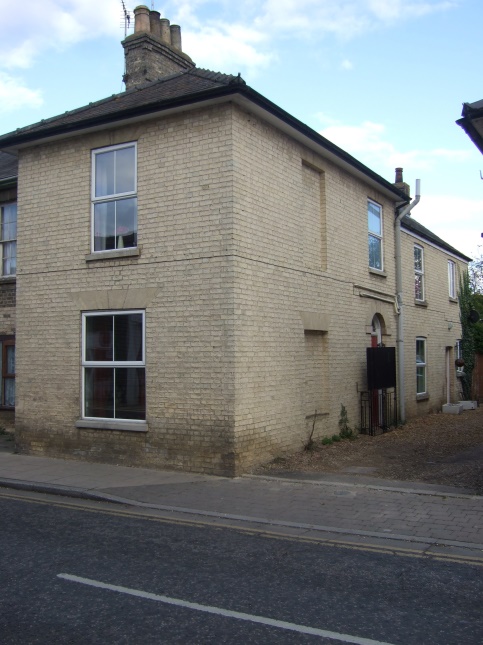 which was the home
where my mother grew up, after their move from Birmingham, and where my
grandparents died. Granddad Cook had bought the Printers and Newsagents[3] business in the next-door building (there
was a narrow driveway between the house and the shop, which gave access to
other houses and to the garden), and I remember being taken by him into the
very noisy printing works at the back of the shop, but (I wonder why?) being
very firmly told to “keep out”. The house was substantial and quite old, with a
“front room” that was kept for Sundays and visitors, and was otherwise never
user (later, it became a sitting-room cum bedroom for Grandma, when climbing
the stairs became a problem for her).
which was the home
where my mother grew up, after their move from Birmingham, and where my
grandparents died. Granddad Cook had bought the Printers and Newsagents[3] business in the next-door building (there
was a narrow driveway between the house and the shop, which gave access to
other houses and to the garden), and I remember being taken by him into the
very noisy printing works at the back of the shop, but (I wonder why?) being
very firmly told to “keep out”. The house was substantial and quite old, with a
“front room” that was kept for Sundays and visitors, and was otherwise never
user (later, it became a sitting-room cum bedroom for Grandma, when climbing
the stairs became a problem for her).
Next to this was a hall, with a very large walk-in cupboard in which Auntie Winnie (their middle child, who lived in the house almost all her life) kept fabrics, wool and embroidery materials. Auntie Winnie was a brilliant needle-worker, and knitted and sewed things for the family (most of my school socks and jumpers came from her) and for the Baptist Missionary Society – at the time of her death, we speculated on how many THOUSANDS of children all over the world had worn clothes made by her: anyway, my mother was always fascinated at the “treasure trove” that was in this cupboard.
Next to the cupboard were the
stairs, then the living room, and beyond that the kitchen and larder; the
kitchen was fairly large, and the larder was always cold (food and crockery
were kept there); in the kitchen was a stone/glazed sink. In our childhood
there was no bathroom in the house – the toilet was outside, and people took
baths in a tin bath on the kitchen stone floor (I once forgot, and interrupted
granddad in mid-ablution, to 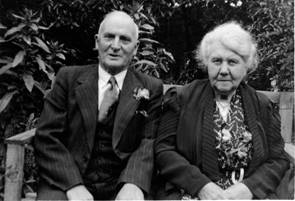 mutual
embarrassment). Over the back door were a row of servant’s bells, with a
different pitch for every room, which we children loved to ring, and there was
a panelled staircase leading to the “servants bedroom”
over the kitchen, which I think had been my mother’s room as a girl, and was
the favourite for us children when visiting.
mutual
embarrassment). Over the back door were a row of servant’s bells, with a
different pitch for every room, which we children loved to ring, and there was
a panelled staircase leading to the “servants bedroom”
over the kitchen, which I think had been my mother’s room as a girl, and was
the favourite for us children when visiting.
Granddad and Grandma (pictured for their Golden Wedding in 1949) were in appearance products of their era – upright in every sense of the word; I cannot remember Grandma in any colour other than black (or possibly black and dark navy mixed) with white trimmings. They were strict but very kind; at my birth, Granddad gave me a gold half-sovereign, which I still have (he had invested in gold sovereigns, and given one to each grandchild – but by the time I came along, the sovereigns had gone and so I had a half-sovereign, and by Rosalie’s time I think they were all gone). Granddad had a pocket watch, which I much admired (I had a pocket watch myself when at the Grammar School, rather than a wristwatch) and a waistcoat to put it in. He sold the business while we were still children, but remained as church secretary at Soham Baptist Church for many years.
We went to stay at Soham about every other year, travelling down by train (hauled typically by GNER Gresley A4 pacific locos, like “Silver Link” and “Sir Nigel Gresley” and memorably “Mallard”). Because both my parents had lived at Soham, we were always welcomed by the church folk, and indeed right up to Auntie Winnie’s funeral in 1997 there were families there who remembered Mum and Dad from their years in Soham. Uncle Clarence lived just down the road (his wife Bovie ran a sweet shop!), and her family (Staples) owned a butcher’s shop just opposite the Parish Church. Great-Aunt Clara Banyard also lived in the town, and my mother’s school-friends in the area meant lots of people for us to visit. Add to that playing in the “rec” (recreation ground), and the stream and ducks, and it was fun for children. One visit to Aunt Clara resulted in us seeing television for the first time (“Muffin the Mule” was on).
The Harris Grandparents We did not visit Stony Stratford as often as Soham, probably because my mother had never lived there, whereas they had both lived at Soham and knew the contacts; but the visits we did make remain in my memory. I was able to play with my father’s old toys (a grey-metal early Meccano set, and a set of “architectural” building bricks, which we still have in their original box), and sleep in his old bed (black with polished brass knobs). Dad and I sometimes cycled over while Mum and the girls remained at Soham, and we’d look at Gorrick Spring, the river/canal, visit Wolverton Station (which was on the LMS main line, and ideal for train-spotting), and visit the Baptist Chapel (with historic items in it, including a memorial to an ancestor), the green with the “John Wesley” tree, and to see the two pubs in the High Street, the “Cock” and “Bull” that led to the famous “Cock and Bull story” – attributed to a wife whose husband tried to tell her he’d been working late! The picture shows Grandad and Grandma Harris in 1953.
At some time during my childhood,
Granddad Harris must have had the stroke that led to giving up work; it
affected one side of his mouth, meaning that he slurped his tea a bit, but his
mind was alert and he had a gentle sense of humour. Grandma was a tower of
strength, being active in the church even when quite elderly (she, like Auntie
Winnie Cook, had a presentation scroll celebrating 50 or 60 years of work in
the 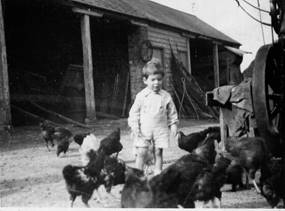 church).
She was a great letter-writer, corresponding with her family in Canada[4] and numerous cousins in the UK. Nothing
was too much trouble for her. From Stony Stratford we have inherited two large
conch shells, which I can remember listening to (to hear the “sea”), and
Granddad’s rulers and brass business plate[5].
church).
She was a great letter-writer, corresponding with her family in Canada[4] and numerous cousins in the UK. Nothing
was too much trouble for her. From Stony Stratford we have inherited two large
conch shells, which I can remember listening to (to hear the “sea”), and
Granddad’s rulers and brass business plate[5].
Life
at Wollaston: I remember very
little of days before Wollaston, but from when we were at Wollaston there are a
few memories that remain. Firstly there are my impressions of wartime,
recorded elsewhere. Then there was another memory – of turning the handle of my
mother’s sewing machine; actually I don’t recall the accident itself, but I do
remember the reactions of my parents when they found I’d done a neat line of
sewing through my finger. I also recall a visit by an elderly relative;
Aunt Louie (Mrs Wiggs),
visited us – she had a walking stick, and I think I must have wielded it a bit,
and hit her!
But the happiest memory is visiting Mrs Jones’ farm with my father, probably riding on a small seat mounted on his bicycle crossbar[6]; the farmhouse was to the right on entering the farm, and outside the kitchen door was a water pump; the first thing my dad did, each visit, was to ask for a glass and pump himself a glass of water – apparently fresher and sweeter than the water we had in the tap at home; I used to keep on pumping, and the water would run along a trench going down to the sheds, and chickens and ducks would scurry to the trench to drink, a wonderful thrill for a young boy.
In 2001, Katie and I re-visited Wollaston one Saturday, and found the Church and High Street much as I remembered it from childhood – except that the house (88 High Street) was mirror image to my memory; I had imagined the front door on the left as you face the house, but it’s actually on the right!
Also, in 2009 I discovered in my parents’ photo collection a photo of the farm – just as I had remembered it. This picture from 1945 is on the right.
Holidays in my early youth were few and far between, due to the war, though I recall going to Hunstanton[7] when very young (I remember only that it seemed very cold!).
Link forward to next chronological or next on this subject : link backwards to the Introduction, or to the family
documents index[1] I used to say that I came from “a little town in Cambridgeshire that no one has ever heard of”. That’s all changed, tragically: RIP Holly Wells and Jessica Chapman, August 2002.
[2] I have recently rediscovered letters of congratulations at my birth, which my mother had kept for me in an old cardboard box that had laid in the loft for many years; it is interesting that the letters refer to the imminent move, and two are in fact from folk at Wollaston.
[3] These days, a newsagent simply sells papers and stationery, but my Grandad was a news Agent – he received news from London and printed it, with local news, in the local paper he owned; he also copied some of the more interesting local news up to London.
[4] Her parents, T W and L G Moores, and all her brothers and sisters, had emigrated to Canada in the early 1900’s.
[5] The plate tells an interesting story. The printing business was owned by a Mr Barlow, and Grandad had been his apprentice before going to work in London for Eyre and Spottiswood (who had a rare licence to print the AV Bible, and who did printing for Buckingham palace … when Grandad returned to Stony Stratford he was known as the King’s Printer); anyway, when Mr Barlow came to retire he gave Grandad first refusal on the business, but Grandad accepted it. So the plate has BARLOW engraved on one side and HARRIS on the other – very economical!