My Golden
Milestones
88 High Street, Stony Stratford,
Bucks.
Sorry – I have no photo of this!
Our home was behind and over the stationary shop on
the main road through the town, the printing being alongside the living
accommodation. We had an upstairs sitting room, which gave a grandstand view of
carnivals, and other processions. There was a garden behind, larger than the
one we had left, with some fruit trees in it. The premises were rambling, and
the toilet outside. Electricity came to the town in 1927, and we had the luxury
of electric light in the more important rooms, put in, if I remember correctly,
at the cost of £1 per point! There were gas lamps in the printing works. This
was my home in adolescence, indeed until the end of 1936, when I went to Soham.
 Stony
Stratford is a very old town. Its legends are numerous, and here are a few. In
the High Street are two inns, called respectively the “cock” and the “bull”,
said to have given rise to the phrase, “a cock and bull story”. A plaque marks
the house where two young princes stayed for a night on their way to the Tower
of London, where they were murdered. At the northern end of the town once stood
a “Queen Eleanor Cross”, marking the fact that her body rested in the church
while being carried from the Midlands to London. In the market place is an old
elm tree, under which John Wesley is said to have preached, and found the
people “stony by name, and stony by nature”. And on the Calverton road there is
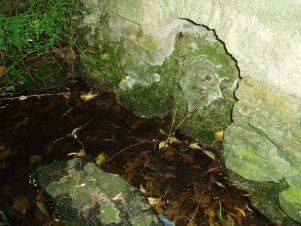
a very reliable spring (recent picture),
concerning which it is said:
Stony
Stratford is a very old town. Its legends are numerous, and here are a few. In
the High Street are two inns, called respectively the “cock” and the “bull”,
said to have given rise to the phrase, “a cock and bull story”. A plaque marks
the house where two young princes stayed for a night on their way to the Tower
of London, where they were murdered. At the northern end of the town once stood
a “Queen Eleanor Cross”, marking the fact that her body rested in the church
while being carried from the Midlands to London. In the market place is an old
elm tree, under which John Wesley is said to have preached, and found the
people “stony by name, and stony by nature”. And on the Calverton road there is
a very reliable spring (recent picture),
concerning which it is said:
If Gorrick spring should ere run dry,
Beware,
for pestilence is nigh.[1]
 The town
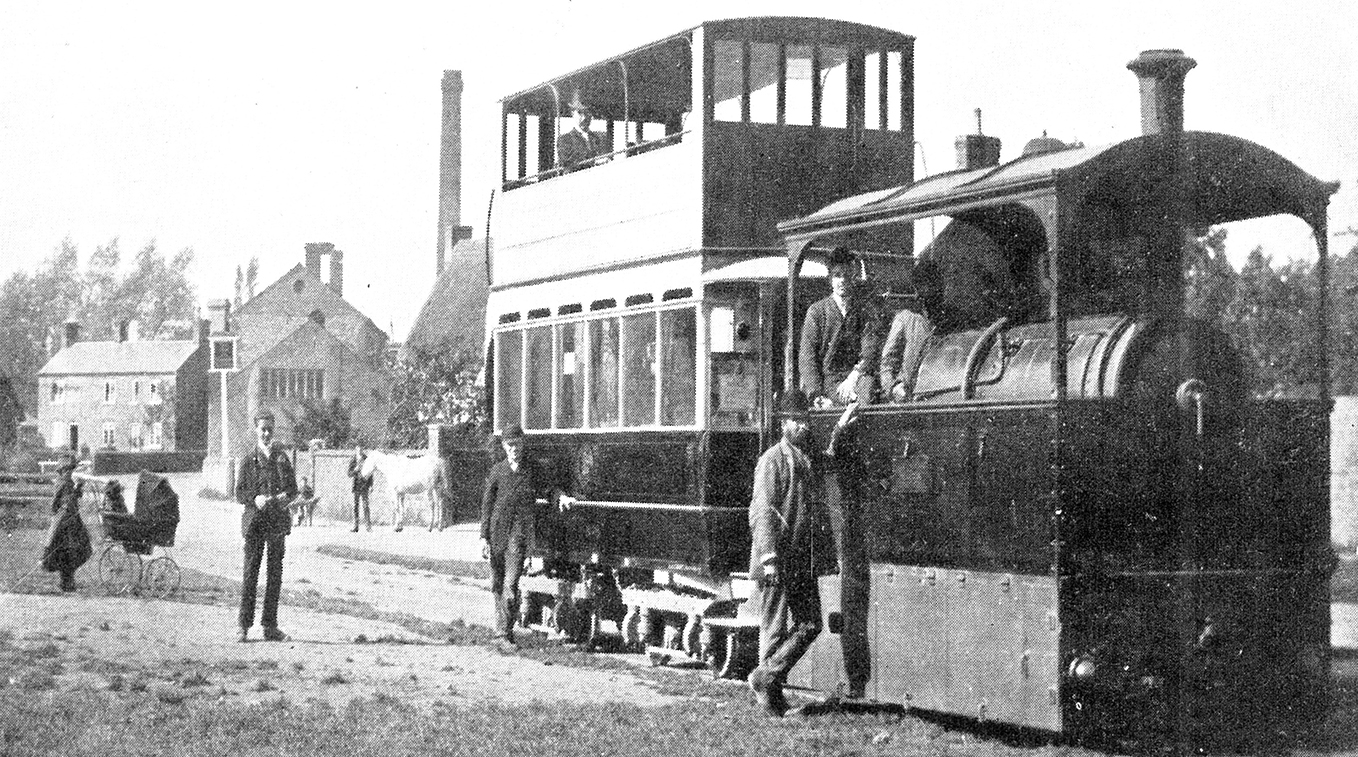
was linked with Wolverton (2 miles away, where the nearest station is) by a
tram, consisting of a steam bogie drawing one or two carriages. This “puffing
Billy” (pictured ca 1888) was run by
the railway company. The track ran by the side of the road, crossing it at one
point. By 1926 it was facing competition from the more manoeuvrable buses; it
was halted for the general strike of that year, and never ran again.
The town
was linked with Wolverton (2 miles away, where the nearest station is) by a
tram, consisting of a steam bogie drawing one or two carriages. This “puffing
Billy” (pictured ca 1888) was run by
the railway company. The track ran by the side of the road, crossing it at one
point. By 1926 it was facing competition from the more manoeuvrable buses; it
was halted for the general strike of that year, and never ran again.
My education was continued at the Wolverton County
Secondary School (1924-27). The Headmaster was E.J. Boyce, with whose younger
son Jack I was quite friendly. With my other school friend Roy Linnell, I corresponded until his recent death. I was also
on good terms with Reg Johnson, and we used to cycle
to and from school together. He was older than me, and later taught at Finchley
County School, where I had been a pupil. Unfortunately, he was struck down in
his prime with a form of epilepsy, and lived at home for years, filling out his
time by marking exam papers and mending clocks.
After taking the Oxford School Certificate exam in
1927, I left school not knowing the direction that my life was to take, and
began work in my father’s business, with a starting wage of ten shillings per
week, and was so engaged for five years. It was a small country business, and
gave opportunity to learn most of the processes of printing, as it was then
practised[2]. A
variety of jobs came our way: - Programmes, posters, tickets, handbills, church
magazines, council minutes, local election printing, school sports and speech
day programmes, etc. All type-setting was by hand, but occasionally for larger
jobs my father would get help from Mr. Line, of Newport Pagnell, who had a
mono-type setting machine. The printing machines were treadle powered, but it
was a great day when my father replaced one of them with a Heidelberg
automatic, powered by a small electric motor. It took some time to master the
finer controls, but at least it took the slog out of long runs. Then when I
went to College, and he was left alone, he invested in a linotype setting
machine. But I fancy that was never quite the boon he hoped it would be.
My chief form of recreation in those adolescent years
was cycling. And the two wheels came in very handy when holidays came round. In
1925 I cycled to East Finchley, to spend a week with my friends, the Blakey’s.
In 1927 I went to stay for a week with my grandfather’s brother, Percy Moores, his wife Kate, and some of their family, in
Smethwick, Birmingham. They were of the Plymouth Brethren persuasion, and
during the Sunday morning service, before the “breaking of bread”, my uncle
introduced me to the meeting as a young Christian who had recently been
baptised. I may have felt a little embarrassed at the time, but afterwards
realised what a gracious and encouraging thing he had done. In May 1928 I
attended the John Bunyan Tercentenary meetings in Elstow
and Bedford. In 1930 I cycled to Fivehead in Somerset
(Reading to Langport by train) to stay with Mr. and
Mrs. Starke, during my time there visiting Wells and Cheddar. And in 1931 I had
a week with my (great) Aunt Louie, who was then widowed,
and living in Brentford, Essex. In May 1932 I had been to Deanshanger
one evening, and on my return found that the River Ouse had risen and flooded
the road at the end of the town. My cycle and I finished our journey on a coal
cart.
My Grandfather died in his bed unexpectedly in the
small hours of the last day of 1927, at the age of 76. He had not been ill, but
I suppose he was worn out. He seemed to be much older than I am now! I had a
great respect for him, though conversation was difficult because of his
deafness. On one occasion we were out walking together, and going into the
churchyard at Passenham, he pointed out to me the
grave of his old schoolmaster at Deanshanger. He said
he could never think of him without a shudder, because of his tyranny over his
pupils in the “bad old days”. My grandfather’s passing was my first encounter
with death. I cannot recall any fear, but it registered in my mind as a fact to
be reckoned with. One consequence of his death was that my aunt Edith gave up
her position in Highgate, to keep her Mother company.
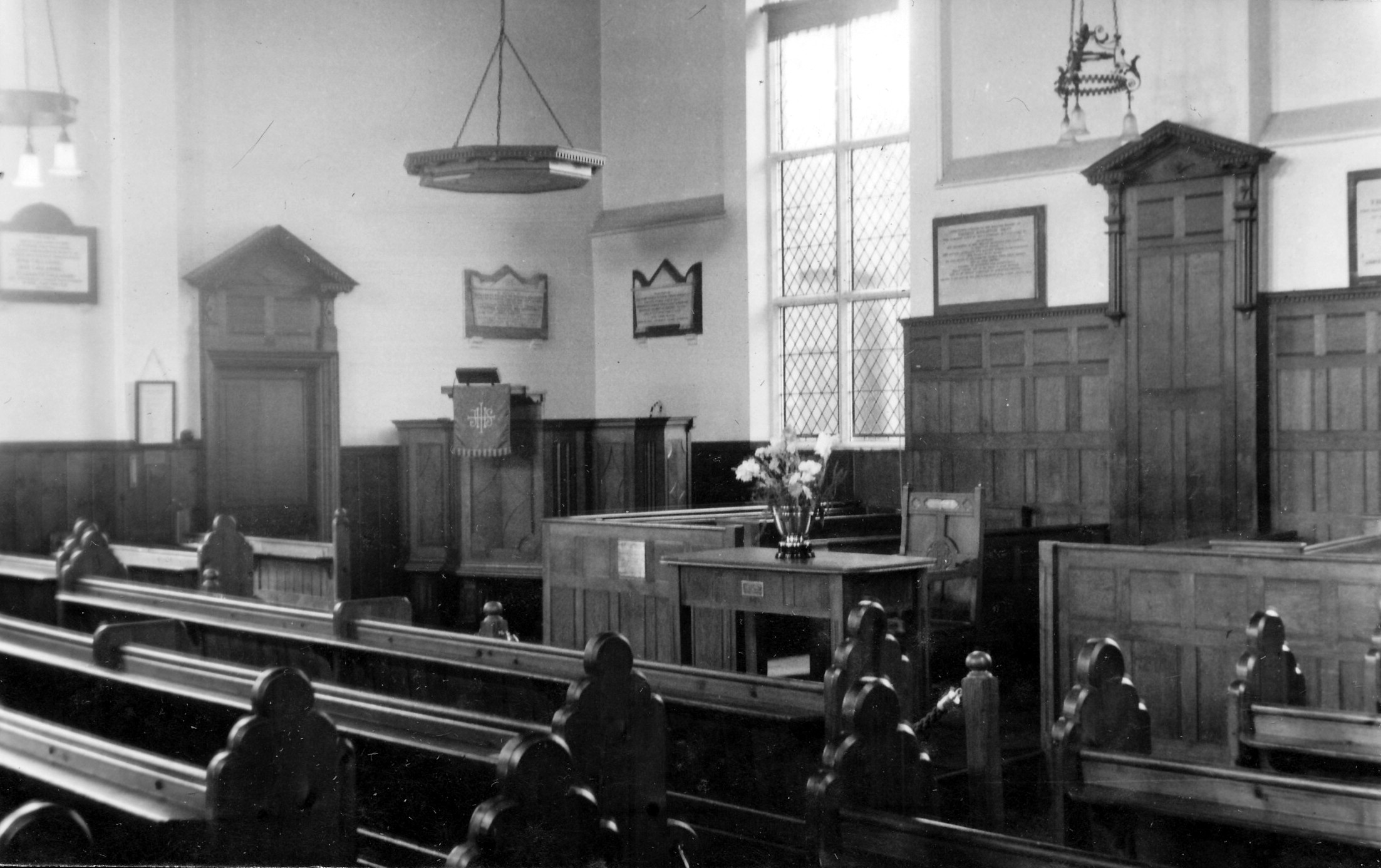
The Baptist church at Stony Stratford (pictured) dates from 1657, and in its
early years had to face the repression of the reign of Charles II. Its first
minister was “ejected from Weedon Beck”, a phrase
which intrigued me until I learned about church history, and found that he was
one of many Anglican clergymen who refused to sign the declaration required by
the Act of Uniformity. In the vestry, among other relics, is a window frame,
taken out of the original building, through which a preacher would escape into
the woods at the rear, on the arrival of soldiers.
The minister when we arrived in 1924 was Rev. Stephen
Cheshire, on the point of retirement after a long pastorate. He was followed by
Rev. John Haydon, by whom I was baptised, along with six others from our branch
church at Loughton, on May 12th, 1927. After being in the young men’s Bible
Class, I was asked to teach in the Sunday school. And then an SOS came from Deanshanger, where help was needed in the Sunday school,
and I along with others, took that responsibility for a while. This in turn led
to my being asked to take an evening 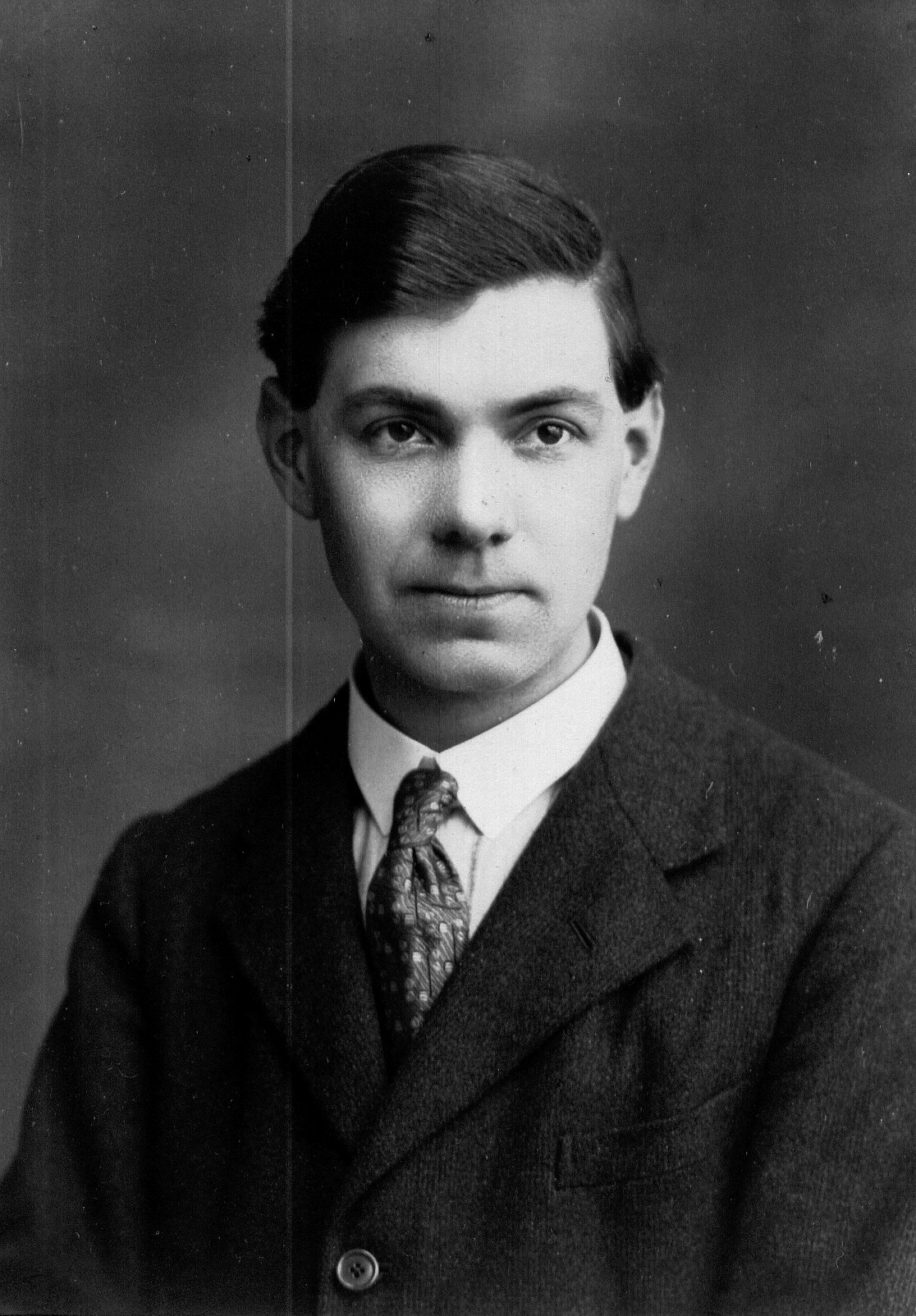 service
at Deanshanger in June 1929. [Picture shows Walter approx. 1928]
service
at Deanshanger in June 1929. [Picture shows Walter approx. 1928]
By this time we had a new young minister from Regents
Park College, Rev J.R. Lewis, who then asked me if I had thought about the
ministry. To which I replied that I had not. But, he having sowed the seeds in
my mind, I began to do so, to examine my own life, and to consider the gifts
and abilities that God had given me. In the meantime, I was asked to preach at
other village chapels in the neighbourhood, and I joined the Stony Stratford
and District Local Preachers Association. Naturally I prayed about the future,
being ready to respond to God’s will when I was sure of it, and asking that at
some point God would give me a token. Then in June 1930 I attended a meeting of
the local Free Church Council, held at Castlethorpe,
at which the speaker was Rev. G.H. Ruffell Laslett, of Watford. He took for his “text” a housing
advertisement, with the legend underneath - “Make your dreams come true”, and
he developed this theme in a variety of ways for Christian life and service. I
felt that it was the token that I had asked for, and from that point I never
looked back.
There arose the question of training for the
ministry. At that time there was a light-hearted tag in circulation concerning
various Baptist colleges:
Rawdon
for preachers,
Bristol
for scholars,
Spurgeon’s
for evangelists,
Regents
Park for Gentlemen!
There was, however, little question where my
preference lay[3];
and I applied to Spurgeon’s, attending the interview on May 26th, 1932, and
receiving within a few days my acceptance, to begin on 5th September following.
Part of the advice was to have a good holiday before then. So in August Mother
and I went to Worthing, and stayed with her cousin Marion Choate (recently
widowed) and her three boys.
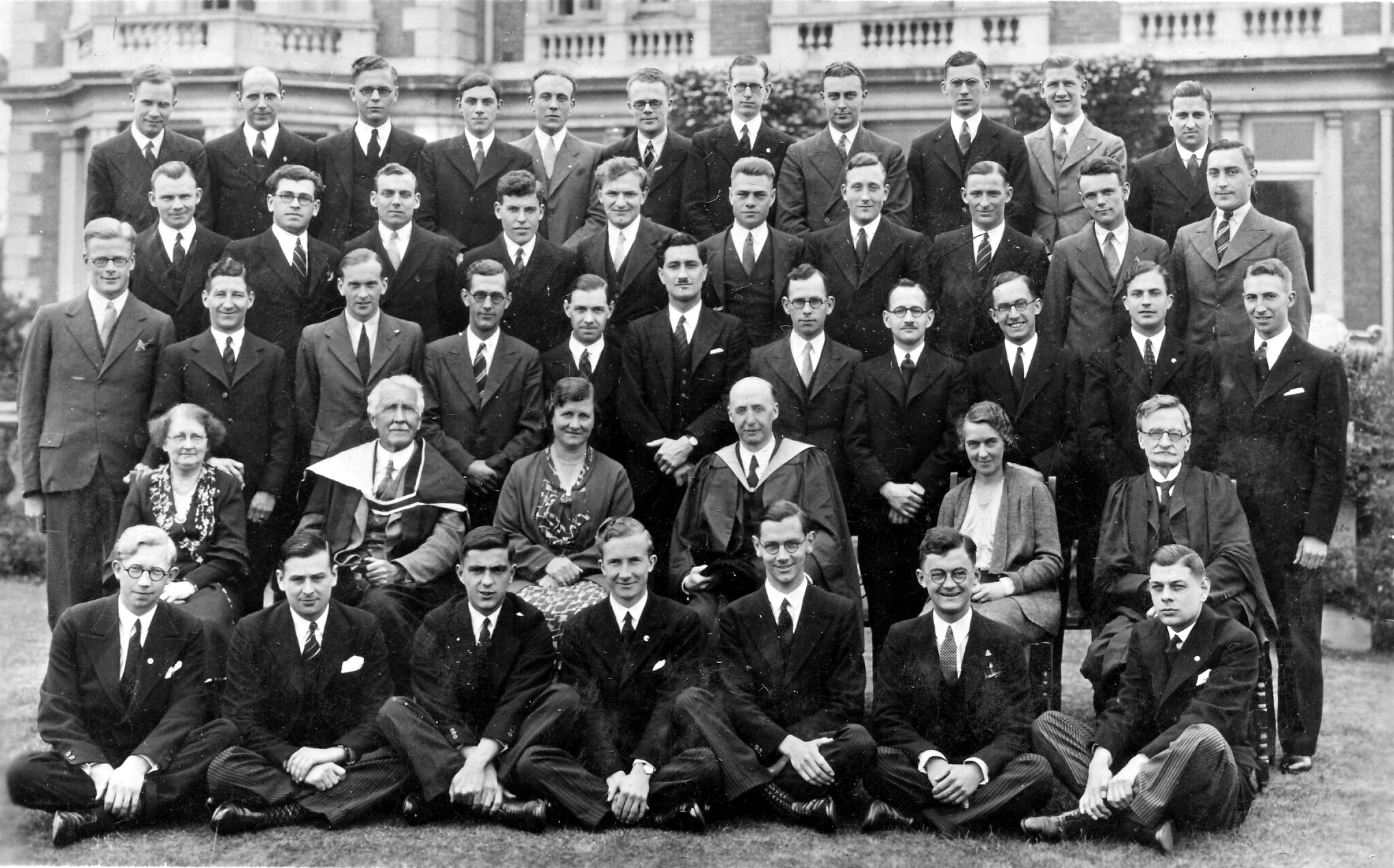 My four
years in Spurgeon’s College (1932-36) did much to broaden my outlook and
increase my experience. The population changed every year, which meant that all
told, one lived in close contact with about 70 other students. And this I
regarded as some compensation for being an only child! I had a great respect
for the Principal, Percy Evans, and he must have had some regard for me, as when
I left he gave me a Greek New Testament, with wide margins for notes, in which
he had written a number of comments[4].
The other tutors were W. H. Gaussen and J. F. Taviner. The latter had a comment that stuck with me; “The doom
of this college will have been written, if ever it can be said that while the
fathers planted the orchards, the sons were content to pass the apple sauce!”
My four
years in Spurgeon’s College (1932-36) did much to broaden my outlook and
increase my experience. The population changed every year, which meant that all
told, one lived in close contact with about 70 other students. And this I
regarded as some compensation for being an only child! I had a great respect
for the Principal, Percy Evans, and he must have had some regard for me, as when
I left he gave me a Greek New Testament, with wide margins for notes, in which
he had written a number of comments[4].
The other tutors were W. H. Gaussen and J. F. Taviner. The latter had a comment that stuck with me; “The doom
of this college will have been written, if ever it can be said that while the
fathers planted the orchards, the sons were content to pass the apple sauce!”
[The picture
shows the College in 1935. Principal Evans and his wife are
seated centre, and Walter is just behind Mrs Evans. Cross-legged before Mr and
Mrs Evans is John Scott Thorburn, who was minister in
Southsea during Bernard’s time there]
When the faculty knew that I had qualified for London
matriculation (through the Oxford School Certificate) they suggested that I
should study for the London B.D. degree. The college was not then of the
academic standard to prepare students for this, so I took a correspondence
course with Wolsey Hall, Oxford. In this way I was able to pass the
Intermediate B.D. in 1934, and the final B.D. in 1936,
becoming the first Spurgeon’s student to gain the degree while in college. Not
that I was over-anxious to get a degree; but it seemed the best use of my
qualification.
From time to time groups of students would visit
churches to lead evangelistic campaigns, and I joined in several of these. Also
in the summer of 1934 I had a student pastorate at the village of Bromham, near Calne, Wilts, which
gave me the opportunity of improving my knowledge of rural life. Also in 1934
news came through one day that Edinburgh University had conferred an honorary
D.D. on our principal. There was great rejoicing among the students, who made a
loud clatter in the corridor, until he came out to explain what it was all
about - given, he said, for looking after folk like us!
During my last year in college, the principle gave us
lectures in homiletics. There came the day when he was to talk about the
conduct of a funeral service. And he began: “There was once a minister in North
London named Bristow.” He had my attention immediately! He went on to describe
the comfort Mr. Bristow used to give to mourners, after taking a funeral in the
Islington and St. Pancras cemeteries, where he was a chaplain, using the
illustration of an empty bird’s-nest in the bushes[5].
And he commended the use of illustration for this purpose.
In October 1935 many of us students went to King
George V dock in Woolwich, to take leave of one of our members, Bill Upchurch,
who was going to China with the B.M.S. It was the first time I had been on an
ocean-going liner, and I was intrigued, on going down
a corridor, to discover the printing works where the ship’s newspaper was being
printed. We then stood on the quayside, and watched the great liner, as it was
pulled away by several little tugs.
In January 1936, King George V died. The message put
out over the wireless was formed by Queen Mary. It ran: “The life of the King
is moving peacefully to its close”. The following Sunday I preached at Epsom[6].
In February 1936 I went to the Albert Hall to see and
hear a dramatised version of Mendelssohn’s “Elijah”.
The whole of the area was given over to the milling crowds on Mount Carmel. A
white sheet was placed in front of the organ, and in front of that was the
altar. At the appropriate moment a flaming torch was thrown over the sheet to
kindle the “sacrifice”, which was then lowered through a trap door. It was all
very spectacular, and I had not seen anything like it before[7].
By the end of the summer term, most of the leaving
men had churches to go to; but not I, though I had preached many times “with a
view”. So I went home, and while awaiting developments
helped again in the printing works. Eventually, after two visits, I was invited
to Soham, Cambs. On Dec. 31st I set off on my cycle
to Fenny Stratford, thence by train to Cambridge, and then by cycle again to Soham, to begin my ministry in January 1937.
Earlier in that December, we had a constitutional
crisis, which resulted in the abdication of King Edward VIII, in favour of his
brother, who became King George VI.
Click here to continue to the next
“chimney”, or to return to the title page.