As I have not told much of my brothers and sisters, now is the time – [139] and also of my parents.
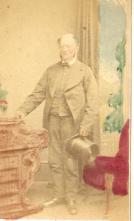
My father (click for photo) was a hard-working man, up early to make the dough 4am sometimes, as we not only sold bread but baked it. The ferment was set mid-day for the next day’s baking, a four-gallon boiler of potatoes was cooked and mashed in a wooden tub, some flour and yeast and water was added, and set to work until evening, say 9pm, when the sponge was set; during the night it worked “and the whole was leavened”. I used to push the lid of the dough trough up, more flour etc. was added and the dough made; it was then weighed up in 2lb or 4lbs, and moulded into loaves – cottage, household, brick or tin. The furnace was lighted before anything else was done, and got the oven hot while the other processes were proceeding; the bread took about an hour to bake, and then the oven was hot enough to cook other things, such as [140] cakes and pies and dinners (footnote 1). Then the yesterday’s grocery orders were got ready, and the bread loaded into the carts, and off we went; we had 2 long journeys and 2 or 3 short; the big horse and cart did the long rounds, and the pony and cart the shorter ones.
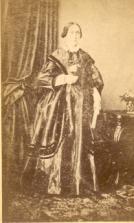
My mother (click for photo) was one of the best. There were 12 of us children, besides a large house to look after, and she helped in the business especially on the drapery side, as she knew more about that than anyone else; and if a lady came to that counter, we used to say “call mother”, and she came. Also she combined business and pleasure occasionally and went to buy drapery and see her mother in London; otherwise she rarely went out. And although my father went to a place of worship regularly, my mother rarely went – she said by the time she had all the family ready to go to church, she was tired [141] enough to sit down and rest; and as she died at 50 I daresay she was pretty well always tired for years before, weak heart.
My eldest sister Maria came home when she was 13 years old, to help us in the shop, which she did very efficiently, and kept the books – she was a good writer, but it was rather young. She did it until the business was sold, and then went into a situation as clerk in a butcher’s shop, and did that until the smell of the meat got nauseous and affected her health, and she then had various jobs until taken into a home on the South Coast, by a charitable lady who made it her life work to minister to aged ladies who had no home of their own (she died at the age of 73). She joined the Baptist Church at Lavender Hill Wandsworth early in life, and was a consistent life member.
I Walter came next, but as this is mostly about my affairs, will say [142] no more of myself here, but will pass on to …
Emily, who was 17 months younger than myself, and as my eldest sister was away at Grandma’s, Emily was my companion. She went to the day school with me for some time, until I was sent to boarding school, and she was also sent to a boarding school at Basingstoke, about 11 miles away by railway (footnote 2), to Miss Graysmanks. When the family got to London, Emily got a pretty good situation that is comfortable, with a Mr Sampson, a draper at Loughborough Junction, who eventually gave up business and went as a Methodist evangelist, and made quite a stir in the Methodist Church. I thought of my sisters, and advanced some cash for the two, Maria and Emily, to go into business at Sydenham near the Crystal Palace, but it did not work – the big shops were doing the trade – and she moved to Waterham, Brixton, and opened a little drapery [143] shop there, and carried on dress making as well. This she did the rest of her life, as long as she was able, and when unable the OAP was available; she died at 83.
Samuel was the next: he went to the local school to begin with, and was a very useful boy to my father (he learned to drive and attend to a horse when quite young), until he too had to go to boarding school. In London, he was taken to work with a butcher, who taught him the business, and managed to get into a business of his own at Brixton, where he got married. And Mr. and Mrs. McLaren, his wife’s father and mother, took the upper part of their house, as they had finished business. He had businesses at Dorking, Dulwich and ……. (footnote 3) in Surrey, and Eastleigh in Hampshire where the L&SW (footnote 4) Railway works were established after removal from Nine Elms, London. [144] Eventually he went to India to work as helper in the Poonah and Indian village mission, and after a time returned to England, and eventually went to Canada.
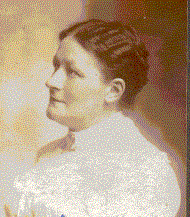
Annie was my next sister (click for photo). After some time at the local school, she went to a ladies boarding school at Basingstoke, and Luther the next boy went to the same school. Annie died at Brixton in her 79th year of her age, having put up a good fight for life, as housekeeper to one or two old gentlemen (footnote 5).
Luther early in life went to Australia, where he got in touch with a firm of solicitors, with whom he worked for some years, and must have made himself valuable to them, for when he told them he was going to India as a missionary, they told him that if he wanted a change, to take a holiday, and they would keep his place open for him; but he went to India and was there some years (indeed, I [145] think he got married there, or soon after, to one of the lady missionaries, and eventually went back to Australia where she came from). They had a son and daughter, Percy and Dorothy.
Josiah was next – was always a small boy, and grew up to go into business for himself, got married, and had a sizeable family, 4 or 5. I believe one boy Bert was killed in the first great war 1914-18. Josiah died at about the age of a little over 40, of some insidious disease caught in South London, where he was managing a grocery business, and was buried by “the Brethren” with whom he joined. I went to his funeral.
Louisa was the next, and trained as a schoolteacher, and had situations as such in South London, and after some changes eventually married Ebenezer Wiggs of Sheerness, and ex-army man and pensioner; he had served in the army for 25 years. They were married from my home [146] at Norwood Green, at the Southall Methodist Church.
And the last one, Arthur, was only about 3 or 4 when our mother died; he got bronchitis the first winter after losing his mother, and always seemed a bit delicate. He went to Woking to boarding school.
At Southsea, I had Josiah, Percy and Arthur on their first leaving school, to give them a start in life, as they could get a grocery assistant place after being with me in my business. I helped Arthur and Percy both into business. Arthur eventually went to Canada, and Percy to Birmingham, where he became manager of a Cooperative store and was there for many years; had a good wife and several children, and retired from the Coop at about70 years of age; but the 2nd Great War came on, and help was short, so the Coop asked Percy if he would go back [147] and help, and on going to work one morning, he got to the bus stop and fell down dead; he was 72 or 3, was in fellowship with the Brethren. His sons and daughters were not only good, but succeeded in their various callings. His wife Kate pre-deceased him; his was a good life.
Transcriber’s footnotes:
1. At least one of Charles Dickens’ books refers to the custom of sending ones food down to the bake-house for it to be cooked
2. From Fleet
3. place left blank … unclear whether “he” is Samuel or Mr McLaren.
4. London and SouthWest Railway
5. The sentence seems quaintly capable of mis-interpretation to modern ears; we must take it in the spirit it was meant.
Click here for the title page, previous section or next section