A
Visit to Zaire, July 1983
5a. Wednesday July
13th
Visitors, comings and goings
Up later today ~ 6:50! We had company for breakfast. One was Mama Kabedi,
the lady who lost a child (the funeral was on the same day as Mum’s); after
that, she had another baby and named him Walter. She brought a cock. The other was a pastor’s wife from Kimpese; her husband had had to give up his “paroise”.
After breakfast another cock was brought ~ they are coming thick and
fast now! Rosalie left to see if the
goats had arrived, leaving a boy who could not have been more than 8 to kill,
pluck, clean and dismember a cock ready for a meal later ~ somehow we could not
imagine Bernard’s boys doing that!
Then we walked over to the Catholic
centre, about 10 minutes walk away, where Rosalie has
been teaching recently. The object was
to visit a new baby in the maternity ward; the new baby, a girl, is a niece for
Kimbangi (his brother Jean-Pierre and his wife Sofi; the older sister is called
Esperance ~ we had seen photos of her before we came). On the way there was very slight rain,
unusual at that time of year. We crossed
a stream covered with white lilies, and saw lots of small chickens ~ they look
the same the world over! The Catholic
centre is quite luxurious, compared with CECO and IME; the hospital had beds
and lots of space, with curtains and bedside tables, and the nun’s house was
spectacular. There was an avenue of Bougainvillea that was a picture!
After getting back, Rosalie went to
CINAT, where the cement factory is, to get one of her marriage certificates
copied. The document is so large that
she had to do it in two halves, and stick them together with Sellotape. Kimbangi
needed this, to hand in at his place of employment, to support his application
for a house. So when it was ready,
Bernard drove Kimbangi to the station, to catch a train back to Kwilu-Ngongo. We sat
on the veranda for a while, with people coming and going all the time.
Then it was time to walk over to Pat’s,
where we had been invited for lunch; it is a 5-minute walk, but with people to
meet we took 20 minutes! Present at
lunch were Pat, Vivienne Green, Jackie Purdoe, Berta,
Alan Stuart, Rosalie, Bernard and me.
Vivienne is here for the weekend, then goes to take language school in
Kinshasa on Monday, then home to the UK and to a somewhat unknown future; she
has asked the BMS for leave of absence[1].
The meal included sausages, baked
beans, tomatoes, peas, greens, chicken, potatoes and fufu, followed by either fruit salad, blancmange
and ice-cream or lemon sponge. Pat’s
excuse (!) was that the meal was to celebrate her and Rosalie’s 10th
anniversary in Zaire, which would get eclipsed by other celebrations at the weekend. Bernard stayed on a bit to help with some
jobs at Pat’s house, and Vivienne came back with us. The next visitor was Pastor Medina, who will
lead the service on Saturday and three others, there was a palaver about
whether enough folk from the church in his district had been invited to the
wedding. Vivienne then went to IME, and
hopes to fix up a visit to Kivuvu (“place of hope”, a
leprosy hospital) for later in the week.
Next Rosalie, Nsunda, Berta and Jean went off
somewhere in the car to fetch some goats ~ destined for the Reception on
Saturday, and Bernard and I are left in relative peace.
Rosalie soon came back with several
sacks of food in the boot of the car, and two small goats, their feet
tied. She also had Mama Wavila in the car, with most of her family, having met them
in Kimpese. At
the same time Alan Stuart arrived in his truck with more goods, and a fridge,
the latter being delivered to the Ndongalas opposite
~ we understand they have had one on loan, and have now got used to it! All the goods were unloaded just outside the
car, and I took a picture[0],
which included a lot of people. They
were then carried into the store-room, which suddenly became full to
overflowing; the people were amazed to see Bernard carrying sacks over his back
or shoulder, rather than on his head!
Everything was chaos and confusion.
Mama Wavila had set out at 6am to walk down
the mountain. At the foot she had waited
a long time for a “camion” (lorry ~ people pay for lifts, and sit in or
cling on to it), and of course she had had no food.
We had intended to set out to meet
Berta’s family, but of course that had to be postponed, as the first thing was
to get tea ready. The first session was
for Mama Wavila, her niece, her family (including
Phyllis and baby Bernard), and for Kimbangi’s older
brother Jean-Pierre; the second session was for us, Pat, Vivienne and Jackie;
the third session (in the kitchen) was for three of Kimbangi’s
cousins, who had arrived later, and Berta.
We have been passing the time in conversation, and in the showing of
photographs, which are always appreciated.
Before tea, and before darkness fell,
Bernard got into conversation (at Rosalie’s instigation) with a group of
students who have their English exam tomorrow.
At first it was general conversation; then they asked if he had any
photos of his family, and he produced some from my trial film. I do hope they will all do well. In and among all this, Rosalie was called out
once or twice. Once was for a rehearsal
at the church, with the ladies choir.
Then she tried to get a key to the building where Mama Wavila and her family were to sleep ~ Rosalie had brought
“sleeping-mats” (like rush mats) for them to sleep on. After some time, we were
back to normal, and we were able to talk to Rosalie about how to distribute
some of the gifts we had brought, between Kimbangi’s family, Mama Wavila,
Berta and their various families.
5b. Thursday July
14th
Up the Bangu
Le quatorze
Juillet ~ Bastille
Day, anniversary of the French Revolution; in conversation this morning it
emerged that the girls in the dormitory next door call that the Bastille! ‘Nuf said!! They are under orders, and have to obey the
rules, like prisoners.
This morning a foraging party had to go
up the Bangu hills to collect saka-saka
(manioc leaves). Bernard was invited to
join, and accepted. They left just after
8:30, and returned just before 2:00. It
had been a tiring tramp, but very worth while. One 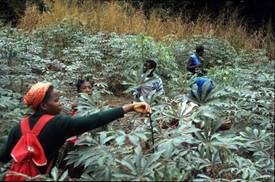
 little job for me was helping to shell haricot beans,
and Rosalie has a picture of me at it, in the passage between the house and the
kitchen. Here is how Bernard described
the trip ..
little job for me was helping to shell haricot beans,
and Rosalie has a picture of me at it, in the passage between the house and the
kitchen. Here is how Bernard described
the trip ..
I feel I’ve stormed the Bastille
today! We set off through the CECO
grounds, over a stream, then along a valley for 1-2 miles, to the river at Zampa. “We” were
Berta, three daughters/cousins of Mama Ndongala (and
therefore cousins of Kimbangi), a schoolgirl from CECO and myself.
As we walked, they taught me some Kikongo and learnt some English ~ and wanted
to know about the countryside, animals etc back
home. As we walked, we sang; they tried
“ten green bottles”, the pronunciation of which was interesting ~ but when they
sang some of their own songs I was astounded to hear 4 or 5-part harmony from
the five girls; they sang parts seemingly naturally, a refreshing contrast to
Britain.
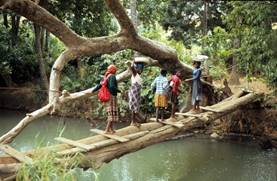
We crossed the river on a 2-log bridge
[Picture 22] (so much easier than just one log to walk over!), and then began
to climb up the Bangu Hills ~ more or less 30 degrees
from bottom to top. At the top we
rested; about one minute, long enough to take a photo! I was amazed at the
difference the hills made to the climate ~ looking back all was hot and dry,
ahead were swirling mists of cloud, and a lot of greenery, relatively
speaking. It seems that the earth up
here, for this reason, is incredibly fertile. So down a valley and up again the
other side, and to the first village, where we were expected ~ this was
9:50. Chairs were brought out for us, then bowls of water to wash, and then bananas. Building work
was going on at the plot next to us; the men had a radio 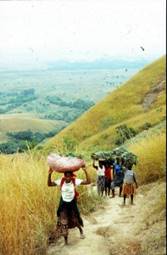 playing pop music!
 After a while, our host led us to his fields, which
were over a ridge and in the next small valley; the manioc grew down the
sloping banks, and we had to pick the plant tops [Picture 23], just 6-8 inches
from the top of the central stem. The
handfuls were packed into the big metal bowls, or wrapped up into cloth
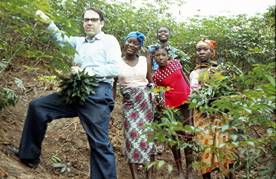
bundles, for the trip back. Berta
“borrowed” my camera and took a picture of me helping pick the leaves ~ and the
other girls were so excited for her that they crowded round to watch, so the
result [Picture 24] shows me doing all the work while they looked on!
After a while, our host led us to his fields, which
were over a ridge and in the next small valley; the manioc grew down the
sloping banks, and we had to pick the plant tops [Picture 23], just 6-8 inches
from the top of the central stem. The
handfuls were packed into the big metal bowls, or wrapped up into cloth
bundles, for the trip back. Berta
“borrowed” my camera and took a picture of me helping pick the leaves ~ and the
other girls were so excited for her that they crowded round to watch, so the
result [Picture 24] shows me doing all the work while they looked on!
Back to the village, and I marvelled at
the way these girls climbed steep slopes (that made me go on all fours at
places) keeping the heavy bowls balanced on their heads [Picture 25]. We thanked our host, and accepted a large
bunch of bananas for Dad. Going down the
Bangu was much easier than climbing up! I was glad to get back, and have a bath
(cold), lunch (of saka-saka, potatoes
and mbele) and a rest, in that
order. Tiring, but a challenge I could
not refuse, as Marguerite had managed it some years earlier.
While I bathed and rested, the girls
(to shame me) and the Mamas were at work, pounding the leaves in big wooden
bowls with polished sticks; the smell of the fresh leaves slowly wafted all
around.
Around the CECO community
The house is getting very crowded, and
this afternoon while Bernard rested, Rosalie and I went for a walk to see some
of the camps included in the campus. We went to the Bible Student camp, and to
one of the school camps. It was quiet
and restful, and I encouraged her to extend the walk, and was able to get
answers to a few more questions that I needed to ask. On our return a “Press Representative” was
waiting to see her, to ask about a report and photo for a (or the) paper ~
probably expecting payment to include the article. She stalled and put him off.
After this Charlotte brought out a
guitar and sang for us, charmingly, mainly in French but with some Kikongo and
even halting English. Rosalie was busy
with Berta sewing her “going-away dress” (using the same material as the
bridesmaids dresses, though she wasn’t going away!), and Bernard became the
most popular person in the whole world when he taught little Phyllis Wavila “this is the way the gentlemen ride” (the words lose
something in the translation to Kikongo, but the actions seem universally
accepted).
5c. Friday July 15th
Guard duty
And we have been talking about St. Swithin’s day! The
weather here doesn’t form an opening gambit of conversation, as in England, for
it is constant, except at the beginning of the wet/dry seasons.
Today Vivienne and Mama Wavila have been doing their best to keep the house free
from the hordes of people who are gathering for the wedding tomorrow. So we have had the table and bathroom more or
less to ourselves ~ don’t ask where all the others are eating and
sleeping! Our first visitor was the
grandfather (or perhaps great-uncle) who lives “up in the mountains”. Rosalie had to do some school work earlier, then finished of her “going-away” dress. Then about mid-morning we carried out a
conspiracy to relieve the pressure on Rosalie, and took her up to Pat’s
house. She went willingly enough, and
had much needed rest and quiet for a couple of hours. So did we ~ thanks
to Mama Wavila and Vivienne, the house seemed almost
quiet! More people kept arriving for the
wedding, but as the exams were over the 6th-form girls were leaving from the
“Bastille” across the road. Kimbangi
arrived in time for lunch, which included stuffed lenge
(like marrow), sweet potatoes, beans etc., followed by lemon meringue pie made
from local lemons and eggs.
Preparations
Then we sat down and started a game of
Scrabble ~ another relaxation. When
about half-way through the game (with Kimbangi in the lead!), Kimbangi’s uncle arrived (his mother’s eldest brother, who
is in a sense the head of the family[2]),
with his wife and Kimbangi’s mother ~ in that order,
as on formal occasions such as first meetings protocol is strictly observed.
After we had welcomed him, Rosalie prepared to go to IME, to fetch her wedding
dress. After she had gone. Mama Wavila’s
husband arrived ~ Tata Ndongala,
not to be confused with the Tata Ndongala who lives
opposite. It is quite impossible to remember, or even identify again, all the
people to whom we have been introduced! I came with the idea that I might
construct a simple family tree of Kimbangi’s
relatives ~ but now I can see that it would be quite impossible, even for his
closest relations.
Rosalie came back with the dress ~
quite a magnificent affair, which fits quite well, but will need ironing in the
morning. Various other people called,
including the pastor from Lukala who will take the
service tomorrow. Soon it was time for the family conclave, or palaver, in the
church. The time suggested was 5:00, but actually it began at 6:00. It was preceded by a rehearsal for the ladies
who are to accompany Rosalie into church tomorrow; that was still in progress,
so we had to wait. Then we were waiting
for Kimbangi’s family, who were having a conclave in
a nearby house. Just before we thought proceedings were about to begin, Rosalie
asked Bernard to drive the car, to take someone into Kimpese. He was a bit late back, and the meeting had
started. We found out afterwards that
he had been arreté (stopped, though
incarcerated was in his mind as a likely outcome!) by the militaire,
and couldn’t make out what had gone wrong.
It seems he had not stopped the car while the Zairian flag was being
lowered. However, one of the other
people in the car squared the police with a little money (20.Z or about £2).
How much is the bride worth?
In Zairian custom, we had been told, this meeting negotiates the terms and conditions of
the marriage between the two families ~ what should we demand as the
bride-price for Rosalie? But on this occasion, the essence of the meeting
seemed to be to give advice to the bride and groom. After prayers and scripture reading, two
people spoke on behalf of Kimbangi’s family; I was
very pleased with what was said (it was translated for me), emphasising that
love is the bond of union, that the difference of colour should be no barrier,
that while the law permits more than one wife the church does not, and that
Kimbangi must love and cherish Rosalie alone, for she will be his own heart.
Then I spoke, for the first time with
an interpreter, saying how glad I was to meet his family, describing our
family, asking them to take Rosalie to their hearts, and saying that we would
take Kimbangi to ours. Then a few words to the couple. After that, various others spoke, and finally
Pastor Dioko gave quite an address, with plenty of
advice on marriage. And finally gifts
were presented, one (a set of glass dishes, from the church at Lukala, which was the reason for the trip to Kimpese) in full view, the others by proxy, as they
consisted of goats, cocks, etc. We were
told that three animals are to go with them to Kwilu-Ngongo.
The sheep that was given several months before was now in lamb, so that is not
to be used for the reception tomorrow.
Restaurant (not for the squeamish)
Following that meeting, six of us went
into Kimpese for a meal at the Fioti-fioti
restaurant. Fioti means “little”, so I
suggested it was the equivalent to the Little Chef! “We” were Rosalie, Kimbangi, Vivienne, Pat,
Bernard and me. It was a sort of stag
plus hen party!
Several times already we have said
“people are not going to believe all this when we get home” ~ on this occasion
the reason was the state of the décor inside the restaurant, plaster hanging
off the ceiling, netting suspended over the tables (in case a lizard fell down
into your meal!), wiring bare and worn cotton-covered flex, dangling from the
walls. But the meal was served promptly
and was tasty; it included plantain (which looks and tastes rather like a
savoury banana), beans, meat, rice, fu-fu
(the girls said it was not the best fu-fu
in the world), and of course fanta orange. The bill
of Z.168 for 6 of us is £2.80 a head!
The owner is an ex-CECO student, who had been a “house boy” to some
Americans. We learnt that on one
occasion he had come to the UK, and through a misunderstanding arrived at
Heathrow with no money. He persuaded to
immigration people to phone his hosts (the parents of a bride of a friend) to
vouch for him. So he left Heathrow, and
not knowing the distances or costs took a Taxi to Nottingham!
Then we went back home, ready for
coffee, a rest and for the great day.
Click to go to the next
section, or return to the title and index