A
Visit to Zaire, July 1983
4a. Monday July
11th
School
This was a relatively quiet day! Our plan for this morning was to get off
early to IME. However, our first
visitors were Berta’s mother and Mama Ndongala (across
the road); after a chat, we set off in the car, but stopped near the top of the
hill in CECO to talk to some of the “chiefs”. They gave Rosalie a message that
the prefêt (headmaster) wanted to see her at
9am; we teased her that she was about to be carpeted! While she went to the
office, we were given a tour round the school, looking in at the labs and
workshops; in a carpentry shed, a gentleman was making a superb table, which
had got to the smoothing stage, and he was very pleased to show us everything
and try to explain what it was used for; Bernard’s French seemed to be
sufficient!
Rosalie found that she had some work to
do. It seems that the marking of exam papers was more strict
than in other schools, resulting in unfair comparison. So she was instructed to
add 10 to the results in three subjects (not her own) for her form, and
re-write all the end-of-term reports, totals and percentages ~ and it had to be
done by this afternoon. So she and
Bernard spent some time doing the routine changes, then when it was a matter of
routine she took her calculator with her and we set off, making our way to the
home of Michael and Brenda Abbott.
Michael was importuned to take us round the hospital, and Rosalie sat
down to do her 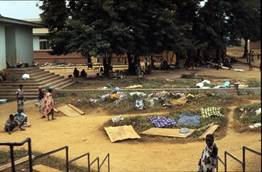 work.
work.
The hospital at IME
I was particularly glad to be at IME,
remembering that Averil Couper (a member from my
former church at Coleford) had been there, and we met some who remembered
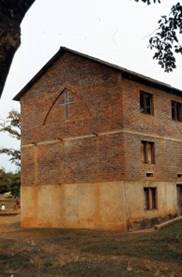
her. We saw the chapel [Picture 7]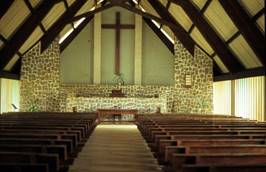 , with its most amazing roof (curved in three planes)
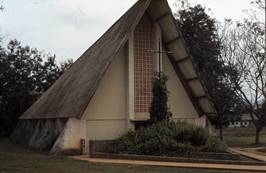 [Picture 8] and the baptistry
behind it. The hospital was a
revelation! Patients are not “cared for”
as they are in Britain, but their families come and camp outside, to do the
feeding and general caring; indeed, for the most time the patients live outside
[Picture 9 and 10], only coming in when treatment has to be administered,
except for the very sick. In the wards (typically
6-12 beds) there were many conditions that we would describe as primitive, but
of course for most of the patients are luxury. We saw a mixture of the very old
and the ultra modern equipment in the labs; the administration
is based on European practices, and seemed very efficient. They are limited by funds, but even more by
the lack of goods ~ drugs, sheets etc must be
imported, or given by friends from overseas; either way,
[Picture 8] and the baptistry
behind it. The hospital was a
revelation! Patients are not “cared for”
as they are in Britain, but their families come and camp outside, to do the
feeding and general caring; indeed, for the most time the patients live outside
[Picture 9 and 10], only coming in when treatment has to be administered,
except for the very sick. In the wards (typically
6-12 beds) there were many conditions that we would describe as primitive, but
of course for most of the patients are luxury. We saw a mixture of the very old
and the ultra modern equipment in the labs; the administration
is based on European practices, and seemed very efficient. They are limited by funds, but even more by
the lack of goods ~ drugs, sheets etc must be
imported, or given by friends from overseas; either way, 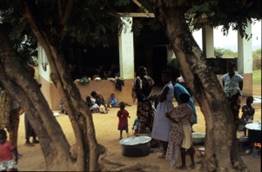 some 50% get “lost” which is disheartening for donors
and hospital alike, and the time delays are large. We saw the dentists areas, equipped as was
typical in the UK about 20 years ago, but excellent for Zaire (indeed, IME
claims the best dental service in the whole country ~ there are only two
dentistry departments attached to hospitals).
some 50% get “lost” which is disheartening for donors
and hospital alike, and the time delays are large. We saw the dentists areas, equipped as was
typical in the UK about 20 years ago, but excellent for Zaire (indeed, IME
claims the best dental service in the whole country ~ there are only two
dentistry departments attached to hospitals).
Like every institution in these parts,
it has to be self-supporting, so it includes all forms of maintenance
work. Among other places, we saw where
wooden limbs are made from English willow, which is the most suitable wood, and
roughly matches the weight of a human limb. The labs were busy, and many
Zairians and Europeans worked together there. We were shown many things funded
by Missionary Societies ~ whereas the BMS sends only people, other societies
send fewer people but more money for 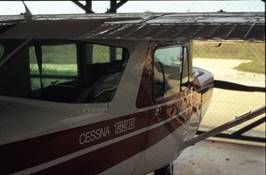 “projects”, such as building and equipping
laboratories, nurses school, etc. Sadly,
some things are misused and spoiled, such as the showers at IME, and fall into
disrepair. How can we help?
“projects”, such as building and equipping
laboratories, nurses school, etc. Sadly,
some things are misused and spoiled, such as the showers at IME, and fall into
disrepair. How can we help?
We then saw a hangar, which is the
property of the Missionary Aviation Fellowship, containing two CESSNA planes
[Picture 11]. But there is no pilot
stationed here at present; the need here, now there is a road, is not as great
as in other places. Finally we called on
Steven and Carolyn Green ~ Steven is a nephew of Rev Paul Rigden-Green,
who has recently come to live in Woodley. Then we collected the car tyre (we
had taken it to have a puncture repaired), and drove back home for lunch, at
which Pat joined us.
More visitors
 This afternoon we had a visit from “little Bernard”
and his parents, Tata and Mama Kiala, who brought us
a large bowl of bananas and other fruit, and flowers (hibiscus, frangipani,
bougainvillea, etc).
It is customary here to name a baby after someone, and there are two Bernards, two Phyllisses, a
Walter, and I don’t know how many Rosalies around
here! But the unusual thing is that
being a name-sake identifies the two people; so Bernard had to talk to “little Bernard”’s parents as “my father” and “my mother”. Later, when Mama Wavila
brought her daughter Phyllis, Bernard had to call her “my mother” and I had to
call her “my wife” ~ and she is 3 years old!!
Mama Wavila has a baby called Bernard ~ no one
explained if the baby had to call his sister “my mother”!
This afternoon we had a visit from “little Bernard”
and his parents, Tata and Mama Kiala, who brought us
a large bowl of bananas and other fruit, and flowers (hibiscus, frangipani,
bougainvillea, etc).
It is customary here to name a baby after someone, and there are two Bernards, two Phyllisses, a
Walter, and I don’t know how many Rosalies around
here! But the unusual thing is that
being a name-sake identifies the two people; so Bernard had to talk to “little Bernard”’s parents as “my father” and “my mother”. Later, when Mama Wavila
brought her daughter Phyllis, Bernard had to call her “my mother” and I had to
call her “my wife” ~ and she is 3 years old!!
Mama Wavila has a baby called Bernard ~ no one
explained if the baby had to call his sister “my mother”!
Later we went with Pat and Rosalie to
take some books back to the school library, and were able to see into the
lecture theatre (it has a staged floor, and would be ideal for slide
presentations, (but they lack slide projector) amplifier and speakers), and met
Pastor Mateka who will preach on Saturday. Returning,
we went into the chapel where the Christian Union (Ligue)
hold their meetings [Picture 12]; this had been superbly fitted ~ the best
(only!) tiled floor we ever saw ~ thanks to gifts from a Missionary
Society. We called on the Moores
(American Missionaries), who have been here for twenty years; they both teach
in the Bible school.
When we got back to the house, we found
Mama Bankombo and her daughter Alice (the nearest
easy pronunciation to “Harris”!), the first child to be named after
Rosalie. Then Kimbangi arrived, in time
to share our evening meal (this included corn-on-the-cob and bananas, but not
together!), and be ready to go to Songololo
tomorrow. After the meal Bernard helped
the girls wash up “to show Kimbangi that men are allowed to do such things!”, while Rosalie showed Kimbangi all the presents we had
brought from friends and relatives in the UK. From Epsom there was a picture of
a “mouse-train” and lots of photos of local landmarks, so all of these had to
be described and explained. There were mass-signature cards from Epsom,
Coleford and Kimble. And Kimbangi
received his gift from Rosalie ~ a new digital watch.
Last Saturday, when Rosalie went to IME
to collect the car, she was asked to give blood, as Anne Davies (one of the
missionaries) needed a Caesarean section.
There is no long-term blood storage here ~ you plan your blood
collections; if you think you will need blood, you go round known matching
donors and collect it not more than so many days in advance. Anyway, the news this morning was that the
baby was born at 9am, and all is well.
4b. Tuesday July 12th
The civil wedding
Life here gets more fantastic every
day! After breakfast (local grapefruit)
we (Rosalie, Kimbangi, Bernard, Jean, Tata Ndongola ~
who lives opposite, is related somehow to Kimbangi, and was to be “his” witness
~ and I) set out at 8am to go to Songololo for the
civil wedding. Rosalie and Kimbangi had
planned this for June 28th, and had made the journey over; that trip was not
fruitless, as they found it necessary to give a fortnight’s notice ~ this meant
that Bernard and I were able to be present.
We drove along the road to Matadi for some
miles, and stopped to let Jean out, to go to his home village some 3km off the
road. He was to collect some of the food
his family were giving for the reception, and meet us at the same spot between
1 and 2pm.
When we later came to the right turn to
Songololo, we noticed that the left turn was
sign-posted (and signs of any description were rare!) to San Salvador in
Angola. Our destination was about 3
miles down a very rough road. It was the
remains of a once-flourishing colonial town, but now being off the (new) main
road and having no electricity or easy water, it has become somewhat
run-down. Kimpese
is now the effective centre, growing and prosperous, but the attitude is “if
the Belgians made 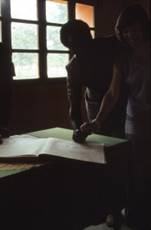 do, surely we can”.
In the centre of the township was a “town hall” (offices), the
administrative and political centre for a very wide area. Outside, we spotted the official notice of
the wedding, for all to see.
do, surely we can”.
In the centre of the township was a “town hall” (offices), the
administrative and political centre for a very wide area. Outside, we spotted the official notice of
the wedding, for all to see.
We arrived at 9am, and were immediately
received by the clerk, who checked over all the details given two weeks
ago. I had suggested that Bernard be the
witness on this occasion, as I expect to fulfil a small part on 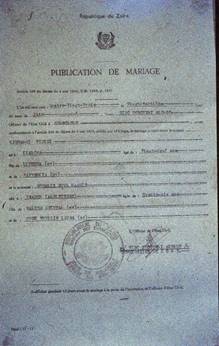 Saturday ~ and he found that he was an “ingenieur des ordinateurs”
(computers). Then we were ushered into
the main room, furnished with a table (draped on which was the national flag),
in front of which were two red easy chairs for the bride and groom and a few
hard chairs for the rest of us! We were
told that we would have to wait for the Commissaire
du Zone (deputy chief administrator, though it is a political
appointment). After about half an hour
he came, and the ceremony proceeded.
Saturday ~ and he found that he was an “ingenieur des ordinateurs”
(computers). Then we were ushered into
the main room, furnished with a table (draped on which was the national flag),
in front of which were two red easy chairs for the bride and groom and a few
hard chairs for the rest of us! We were
told that we would have to wait for the Commissaire
du Zone (deputy chief administrator, though it is a political
appointment). After about half an hour
he came, and the ceremony proceeded.
It consisted chiefly of reading all the
information about the couple that had been supplied ~ dates and places of
birth, jobs, education, entry into Zaire for Rosalie, etc. This was followed by the reading of the “rights
and duties for married people”, a copy of which they later brought away with
them [we hope to get a translation later, to be inserted here]. The Commissaire
clearly emphasised that marriage is “for life”.
At some point he must have asked them to consent to be married, for each
in turn said “Oui”. Then they and the two witnesses signed the
enormous register [Picture 13,14].
We were then informed that drinks would
be served, and were taken out to the rear of the compound, where there was a
“guest house” (used
for important visitors, like the President!) ~ but
alas it was locked, so we returned to the main room. Some time later we
were told that it was now open, so we returned, and found coke, Fanta orange,
and “biere” (Bernard 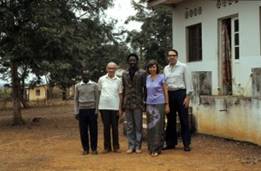 guessed it was more akin to lager) on the table, and
glasses brought. But still we had to
wait for others to join us, and used the opportunity to take some photos [Picture
15] outside ~ including one
guessed it was more akin to lager) on the table, and
glasses brought. But still we had to
wait for others to join us, and used the opportunity to take some photos [Picture
15] outside ~ including one 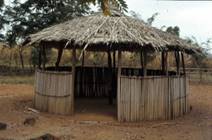 of the tribal meeting-hut [Picture 16] which is a
feature of almost every community. Eventually the Commissaire
and some clerks came, and we sat chatting for a considerable time.
of the tribal meeting-hut [Picture 16] which is a
feature of almost every community. Eventually the Commissaire
and some clerks came, and we sat chatting for a considerable time.
The clerk then brought the copies of
the marriage certificates (three had been asked for) ~ huge sheets they are! It
also appeared that a little “gift” would be appreciated by the Commissaire and clerk ~ so money went hastily into
an envelope ~ and in addition Rosalie gave the Commissaire
an invitation for the reception on Saturday (he didn’t come!). We noticed that the number on the certificate
was XI, and on enquiry found that wedding number I was in 1959 (11 weddings in
24 years). It was explained to us that
only weddings that involve ex-patriots are performed there ~ marriages between
Zairians occur locally, with no formalities!
For the record, the legal document that now binds Rosalie and Kimbangi
in the eyes of the law, is the
ACTE
de MARIAGE No. XI le 12-Jul-1983;
par MIBO TOMOYENI AKONGO (dep. Commissaire
du Zone)
a Songololo en Bas-Zaire
and a copy is to be sent to the British Embassy in
Kinshasa. We didn’t after all have to
sing two National Anthems!
 Back to Kimpese
~ and a detour
Back to Kimpese
~ and a detour
 It
was now 1pm, and we started the journey home.
At the arranged picking up point, Jean was waiting with a sack of
peanuts. He said his sisters were on the
way with more food. (In Zaire the term
brother or sister covers cousins as well ~ at an average of 10 to a family, you
can imagine how many relations people have!
To identify a true brother or sister, you say “brother same mother same
father”). After 10 minutes or so they
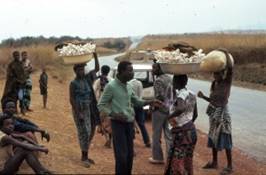
arrived, carrying manioc roots [Picture 17] (these are ground into powder, and
used to make fu-fu ~ something like
dumplings) in bowls on their heads, a picturesque sight! The manioc was transferred into sacks, and
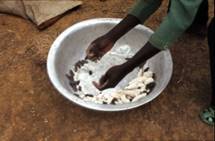
then into the boot of the Renault, and we found 2” long cockroaches [Picture 18]
scampering about in the bottom of the bowls!
It
was now 1pm, and we started the journey home.
At the arranged picking up point, Jean was waiting with a sack of
peanuts. He said his sisters were on the
way with more food. (In Zaire the term
brother or sister covers cousins as well ~ at an average of 10 to a family, you
can imagine how many relations people have!
To identify a true brother or sister, you say “brother same mother same
father”). After 10 minutes or so they
arrived, carrying manioc roots [Picture 17] (these are ground into powder, and
used to make fu-fu ~ something like
dumplings) in bowls on their heads, a picturesque sight! The manioc was transferred into sacks, and
then into the boot of the Renault, and we found 2” long cockroaches [Picture 18]
scampering about in the bottom of the bowls!
A problem then arose ~ the girls
said that Kimbangi’s parents were disappointed at not
going to Songololo, and that we were not calling on
them. So we felt obliged to set off down
to the village in the car, along a narrow and bumpy track, taking the goods
back along the way they had been carried!
This road, which had grass down the centre, was the original road from
Kinshasa to Matadi, and I imagined the transporting
of all the goods along it in the former years.
The village was built 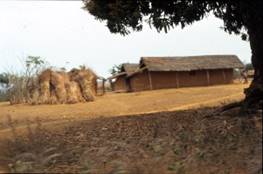 round
a small station, as an offshoot from the ancestral family home; the people are
agricultural folk, selling what they manage to grow. The homes are built of stones and mud bricks
[Picture 19], with thatched roofs, poles supporting the overhang and presumably
giving a veranda-effect. Life is lived
outside the houses, which seem to be used only for sleeping, and chairs were
brought out for us to sit on.
round
a small station, as an offshoot from the ancestral family home; the people are
agricultural folk, selling what they manage to grow. The homes are built of stones and mud bricks
[Picture 19], with thatched roofs, poles supporting the overhang and presumably
giving a veranda-effect. Life is lived
outside the houses, which seem to be used only for sleeping, and chairs were
brought out for us to sit on.
When we arrived at the village, we
found that Kimbangi’s parents were out in the fields. Should we send for them, wait further, or
return? It was the kind of situation
where one runs the risk of offending someone, whatever course is taken. So the matter was talked over with the uncle
who is the senior member of the family.
Tata Ndongala (on Kimbangi’s
behalf ~ it would be impolite to ask something for yourself!) sat down in front
of him for a “palaver”, clapping hands at the beginning and the end. We noticed that some money was passed over,
and it appears (this was news even to Rosalie) that until drinks, or money,
have been given, no one has been “officially informed” (of the wedding in this
case). This explained a remark from the
uncle who we met in Kinshasa on the first day, who said he did not know of the
wedding.
In the end, we returned to the main
road. It appears that the message that
had been given had been entirely from the daughters, and didn’t represent any
resentment on the part of the parents. On
the way back to the road, we met the daughters returning, and of course we stopped
and there was more discussion ~ but it ended in hand-shakes all round. The plans for Tata Ndongala
to be Kimbangi’s witness had of course been made long
before Rosalie knew that we would be there.
We regained the road, and made one
other call on the way home, to another family where there is a girl named
Rosalie; the father is a third-year Bible school student. We made a very short visit, but came 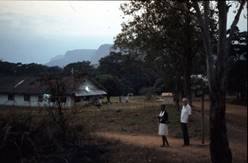 away with a gift of oranges and pineapples.
 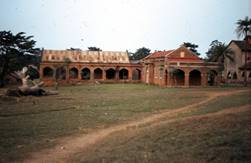 After all this it was about 3.30 when we reached home,
and found yet another visitor waiting, with a gift of a cock ~ she had carried
this down on her head, alive but with its legs tied together. Berta had prepared lunch, so it was not too
long before we were able to sit down ~ to chicken casserole with potatoes, fufu and greens (saka-saka),
followed by bananas and grapefruit (a nice mixture, really!) and coffee,
finishing lunch at 5.15. Since then I
have been relaxing after the days exertions.
After all this it was about 3.30 when we reached home,
and found yet another visitor waiting, with a gift of a cock ~ she had carried
this down on her head, alive but with its legs tied together. Berta had prepared lunch, so it was not too
long before we were able to sit down ~ to chicken casserole with potatoes, fufu and greens (saka-saka),
followed by bananas and grapefruit (a nice mixture, really!) and coffee,
finishing lunch at 5.15. Since then I
have been relaxing after the days exertions.
Pat came in with another pupil who had
some questions for Rosalie, and Bernard and I walked back with her to her
house, where he helped her to move some of Jackie Purdoe’s
luggage (she arrived today from Ngombe Lutete). Pat had a
large jigsaw on her table ~ we put one or two pieces in! ~ obviously
one of her ways of relaxing. She has
invited us all to lunch tomorrow. We
walked back with Berta; Bernard took some photos of the campus [Pictures 20,21], showing the Bangu hills
dominating everything. Berta managed to
knit as she walked; Rosalie has helped her with sewing and knitting, which she
thoroughly enjoys. She is 21, one of a
family who fled Angola twice (1961 and 1975) during the troubles, and
re-started school here when they settled ~ first she had to learn French
(Angola is a former Portuguese colony), and what with that and 3 years lost in
their escape and re-learning some of what she had forgotten, she is now in the
fourth form and doing well. Her family live nearby.
At 8pm, Rosalie and Kimbangi went to meet Pastor Dioko,
to discuss plans (the liturgie) for Saturday.
Click to go to the next
section, or return to the title and index