A
Visit to Zaire, July 1983
3a. Saturday July 9th
Kinshasa to Kimpese
We woke late, and after breakfast and packing up we
set off by car, driven by Justyn, finding our way out of Kinshasa. Justyn is a physics teacher, based at Mbanza-Ngungu. We
were stopped by the militaire (army and police rolled
into one), but Justyn was quick-witted enough to ask them the way to the Matadi road, and put any ideas of searching the car out of
their minds. So along the one tarmac
road in Zaire, the 150 miles to Kimpese, trying to
avoid most of the pot-holes! Impressions
of the country ~ lots of brown vegetation, mainly grass, but with bushes and
trees standing out as green contrasts; the mango trees were in flower, and
there were lemons on the trees; it is mainly scrubland, though there are lots
of trees about ~ wood is sold as a commodity ~ and patches of manioc plantation
(gardens?) among the grassland, sometimes miles from anywhere; occasional
clumps of sugar-cane planted by the roadside, some being sold (and chewed) by
small boys.
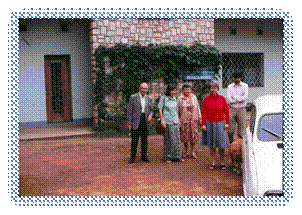
We stopped at Mbanza-Ngungu,
where we saw the church, and were received at their flat [Picture 5] by Margot
Stockwell and Phyl Gilbert, and given a welcome cup
of coffee. There were walnut trees, covered with nuts, in their back garden,
the first time we had seen such trees.
Then we went on to Kimpese ~ the whole journey
took nearly 4 hours, and we arrived about 1 o’clock, ready for lunch, to which
Pat Woolhouse had contributed and Berta and Nsunda prepared.
They had expected us last night, and had prepared a meal and waited up ~
the message via IME that we were to stay in Kinshasa had not arrived. Pat shared in the meal and the conversation,
and there was a lot of catching up on news.
Meeting the people
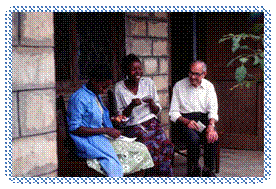 This afternoon Rosalie went
over to IME to collect the car, and we were left in the capable hands of Berta.
Which was just as well, for a whole stream of people came along to greet us. We
sat on the veranda, where there was more light and air. Most of the time on the veranda was spent in
passing round photos [Picture 6], which mostly called forth exclamations of
laughter and surprise; one aspect of English life they found quite amazing was
a photo of Katie in jeans ~ in Zaire a lady never ever wears men’s
clothes! Quite impossible to list all
the callers, but the first was Lydia (whose wedding photos we had brought from
the UK) and Pastor Dioko; they also included a stream
of pupils, keen to try out their English, some of the deacons and the heads of
the primary schools and their wives (there are two schools, one in the morning
and one in the evening, in the same building).
This afternoon Rosalie went
over to IME to collect the car, and we were left in the capable hands of Berta.
Which was just as well, for a whole stream of people came along to greet us. We
sat on the veranda, where there was more light and air. Most of the time on the veranda was spent in
passing round photos [Picture 6], which mostly called forth exclamations of
laughter and surprise; one aspect of English life they found quite amazing was
a photo of Katie in jeans ~ in Zaire a lady never ever wears men’s
clothes! Quite impossible to list all
the callers, but the first was Lydia (whose wedding photos we had brought from
the UK) and Pastor Dioko; they also included a stream
of pupils, keen to try out their English, some of the deacons and the heads of
the primary schools and their wives (there are two schools, one in the morning
and one in the evening, in the same building).
By the time Pastor Dioko
came Rosalie was back, darkness had fallen, and we were back indoors. This was
about 6.15pm ~ we had noticed that here the noon sun is due North,
and the people showed incredulity that in England the time of sunrise and
sunset varies so much! After conversation, he led us in prayer ~ quite clearly
prayer means a lot to the folk here, and God is very real to them. A few of the
callers can speak a little English, but most use French or Kikongo. But Bernard has been exercising his memory,
and making progress in French conversation; it has all been very light-hearted,
and nobody minds mistakes. Some people have been asking about our impressions
of the country! The weather ~ hot in Kinshasa, quite cold in Mbanza-Ngungu (which is high in the hills), pleasantly cool
here; chiefly cloudy at this time of year. The people ~ there are masses
of them everywhere, strolling about in groups, or singly, sometimes far from
human habitation. Few are employees;
most are self-employed, or do moonlighting jobs! Conditions here are a challenge to the
resourcefulness of the people. No parking restrictions; road travel is a
free-for-all. Everyone is very friendly, especially here at Kimpese.
We had tea at about 7.15pm. Then we spent the rest of the evening
talking with Pat, and showing her the presents and photos (again!). I was to sleep next door, in the home of a
Scotsman, Alan Stuart, who is a widower, and Bernard has a bed in the spare
room here.
O Kwilu-Ngongo
|
<17>
|
________ Mbanza-Ngungu | Kimpese To Matadi à
|
|———<150>————+—O————<40>———+——<32>—O——<12>———+———>
|________| /
| | |
Kinshasa /
IME CECO <5>
To Ngombe Lutete To Songololo
Our road map (distances are
km)
3b. Sunday July 10th
Our first country “road”
What a Sunday!
We rose early (too early according to Bernard), and set off about 7.45am
to drive to Kwilu Ngongo,
where the sugar plantation and factory are, and where Kimbangi lives and
works. We drove several miles (or rather
kilometres) back up the Kinshasa road, then turned off
on a country road, which we sampled.
Potholes were everywhere, the road very dusty, with lots of loose
stones, and the car rattling and protesting all the way. There was a place along the way where the
road split, and it amused me to consider this a “dual carriageway”! There were plank and girder bridges of
various states of design and maintenance.
I formed an increasing opinion of the makers of Renault and Peugeot
cars, which can stand up to all the pressures on the suspension.
We arrived in the hotel (the “Hotel de Luxe” ~ though
to describe it as pretty primitive would be generous) where Kimbangi lodges,
but he was not yet in from work. He had
been on the night shift, 11pm to 7am. He
came soon, had a wash, and then we all (Rosalie, Kimbangi, Berta, Jean (Kimbangi’s younger brother), Bernard and I) went to the
CBFZ church on the sugar estate. While
we were waiting, a colleague of Kimbangi had surprised us by using his personal
walkie-talkie (all the estate foremen
use them), and using the phonetic alphabet, ALPHA, BRAVO, CHARLIE, DELTA and so
on ~ this made for quite a conversation, as Bernard convinced him that he knew
some English after all, and then translated the words for him.
Sunday morning service
The service presumably began at 9.30 or thereabouts,
and we arrived at 9.45 while the congregation were singing “How Great Thou art”
(in Kikongo). We entered, the objects of
attention, and four of us were given seats on the platform. Each of the choir
groups had its turn at singing, and Bernard noted that part-singing was
commonplace, sometimes 5 or 6-parts at once.
Rosalie said that in the villages, the harmony is spontaneous ~ there
are written harmonies for the “better trained” town/city choirs; the African
voices find “accidental” notes very difficult, and so the tune is changed slightly
to avoid them. The “music group”
consisted of a selection of drums and recorder-like instruments, used most
effectively to generate a sense of praise and joy. One song from the children
was dramatised.
When the time came for welcomes, all visitors were
introduced and welcomed with acclamation; as they were greeted, the greetings
were “returned” to the places they had come from (Woodley in our case ~ the
people were told to shout especially loud to reach all the way to England!). The words used were ...
MOSE (clap) “One”
ZOLE (clap) “Two”
TATU (3 claps) “Three”
SIMBA (hold hands above head)
FIDISA! (wave
arms and hiss loudly, as the greetings whizz their way).
A student from the Bible school at Kimpese gave the sermon, based on Luke 13, 22-14. There was a dedication service (only the
mothers were there ~ the fathers were at work), after which a verse of “When
mothers of Salem” was sung. Another
song we recognised was “Rejoice and be glad”
(the songs and tunes in the book were attributed to well-known initials,
such as SSH, BCH, CSSM, Alexanders, MHB, SOP and Sankey, but there were more
traditional African tunes and songs too).
Then came the offering, the people processing round the church, and placing
their gifts in washing-up bowls on the communion table ~ one for men, one for
ladies. After this we made our escape,
having been in the service for about 2 hours.
The sugar estate
Then we drove down the hill to the
township in the sugar-cane plantation, and Kimbangi took us on a tour round the
sugar factory, where he is in charge of organising teams of workers, and
responsible for the crop yield in his sector. His job is somewhat more than
that of a foreman; he has to decide on planting, fertilisation, growing cycle,
and all the cycle of production of the crop, and has to use his agricultural
knowledge and maths to see that the whole process works smoothly and yields the
best sugar content. There are some seven
thousand employees in the whole concern.
It is a tremendous undertaking, and acres and acres are used to grow the
canes. The first and last thing you
notice is the pervading sickly-sweet smell of cut sugar-cane ~ it gets
everywhere!
First we went into the office, and saw
maps of the estate, and the production control methods ~ they have an IBM and
at least one DIGITAL[1]
computer there, miles from anywhere, and Rosalie thought there might be a job
there for her in the future! Next we saw wood-fired steam trains bringing the
cut sugar-cane to the factory; before cutting the cane, they burn it ~ this
destroys parasites, and burns off some of the outside edge of the cane, but
doesn’t affect the juice. The cane is
then unloaded into water baths, and then put onto a conveyor belt ~ it is
crushed 4 times in mills, each time extracting more juice and making the
left-over fibre finer ~ in the end it is like grass-cuttings, and is used as
fertiliser. The juice then goes through a number of chemical processes,
including being mixed with calcium carbonate (crushed limestone ~ another
international language ~ the use of “CaC03”), and filtration, then evaporation
~ all the time removing the impurities and thickening the juice.
In the end it is molasses ~ thick brown
treacly liquid, which is stirred and cooled; this then oozes down an aluminium
slide very very slowly, drops into a whirling
tumble-drier, and is suddenly sugar ~ a really magical touch, that almost has
to be seen to be believed. The foreman put a wooden scoop into the drier and
got out some sugar for us to taste ~ it has a brownish tinge (we might think it
slightly dirty at first sight; what we buy in England is refined again), and
the crystals are a fraction larger than we are used to, but it was warm and
sweet. Then we saw the sugar travel down another conveyor belt, cooling, and
then being packed into 5kg polythene bags (automatic weighing, untouched by
human hand at this point), and the bags into 50kg sacks. At this time of the year, the bags go into an
enormous warehouse, where they are stacked up to the roof ~ this is then used
to ship to the ports at a steady rate through the rest of the year.
We than walked around the
out-buildings; the whole establishment is self-sufficient, except for diesel
oil, so in addition to the processing of the cane into sugar, there are
maintenance departments for the vehicles and railway stock that are used. We also went some way off, to visit a quarry
where the limestone is excavated; on the way we stopped in some of the
cane-fields, say the cane being cut (as close to the ground as possible, as
that is where the best juice is, and then lopped off a foot from the top of the
stem, where the juice is bitter). We
were told that cane is planted by putting about 6-8” of cane stem into the
ground ~ this sprouts, and grows the first years cane.
When the first cane is cut, the stumps sprout again for the second year, then
for the third year. After the third
year, the stumps are bulldozed up, and the ground is left fallow for a year,
then dug and re-planted all over again.
The cane is cut over some 5 months, 24-hours a day, then the teams
concentrate on planting and growing for 5 months, and there is a 2-month gap
where they do maintenance and have any holidays!!
By this time, about 1.30, we were ready
for lunch, which we had in the factory managers’ restaurant. A very substantial lunch, suitable for sugar
workers but rather more than we could cope with; the menu was
Oeufs a la Russe
Entrecote a l’os (Goat)
Pineapple
Coffee.
Kimbangi paid for us all; he has
favourable rates, and can use that restaurant whenever he wishes; however, it
was clear that he had made some “special arrangements” with the manager,
suitable for this first meeting with his father-in-law, and the flowers, menu
(on an IBM punched card) and chat and giggles from the waitresses were the
result.
The factory is a Belgian foundation,
the second largest organisation in Central Africa, and some of its high-ups
live in a very nice avenue (you could say millionaire’s row, comparatively
speaking). We called on one lady in this
avenue, Mrs Welby, a Dutch lady married to an
Englishman; he is production manager, and she handles PR for the firm, and was
currently organising a 30m x 30m display for the Kinshasa trade fair. She kindly brought out some drinks for us ~
Coke and Fanta-type orange are the standard offerings, both bottled by a
factory owned by the sugar company (CO2 is a by-product of the purification
process, and sugar is available!).
A village pastor
We then went back to the hotel, and
left Kimbangi there to get a few hours sleep before
going on to the 11pm shift. It was now 5
o’clock. We then called on the pastor of
the town church in Kwilu-Ngongo, Tata Luzolo, who has been very friendly and helpful to
Rosalie. He lives in a very humble
house, rented for him by his church, but typical of those in the village;
mud-brick walls and tin or thatched roof, but plastered inside, and with
sideboard, table and chairs, some photos on the walls, and a radio. His paroise
(parish!) includes many villages, all the way to the main road; some 20,000
people in about 17 x 17km area. He is
doing a fine job in very difficult circumstances. In each village there is what we would call a
house-group, with its own teacher/leader, and the Pastor visits each group in
turn; all the leaders meet monthly for training and communion. Rosalie and Kimbangi will have to choose
between his church here and the sugar church where we were this morning. We were asked to pray regularly for the
church at Kwilu-Ngongo, and were assured that they in
turn would pray for us.
By now it was 5.45, and we made for
home, travelling most of the way after dark.
A very brief call at IME, to deliver and collect messages, concluded the
day. A most interesting day, full of new
experiences, but rather tiring, and we were glad to be quietly at home, to
reflect on the day and express our impressions!
Pat and Lelo (a friend and former colleague of
Kimbangi’s, who teaches agriculture at CECO) visited
us. Lelo paid very generous tributes to Rosalie.
How can one describe Kimbangi? He is very dynamic, proud of his work and
family and success, yet kind though firm.
He was glad to show us round, and explain what everything was for, very
friendly, and very much at ease with us, as we were with him. Both he and Rosalie have strong
personalities, and we remarked that this was going to be an “interesting”
marriage! From him, and indeed from all
the Christians we have met today, we have had smiles and warm welcomes.
Click to go to the next
section, or return to the title and index