My Golden
Milestones
6.
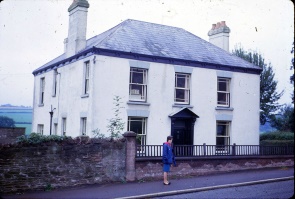
The Manse, Staunton Road, Coleford, Glos.
The Forest of Dean is situated in the angle formed by
the rivers Severn and Wye, and in days before modern road development it was a
somewhat restricted and enclosed area. The principal occupation was originally
coal mining, but in our time the National Coal Board was closing its pits as
being uneconomic. There remained several private drift mines, in which the
access was by sloping path driven into a hillside. We were intrigued to learn
something of the traditions and folklore associated with the mines; and with
the maintenance of the forest, the oaks of which had at one time been used to
make the navy’s ships. The Forest has now been considerably developed as a
tourist area.
The gap, left in the employment market by the closure
of mines, was gradually filled by the establishing of light industry. The
principal employer in Coleford was Carters (part of
the Beechams group), the soft drinks factory, where
Ribena and other drinks[1]
were manufactured.
Robert Forester Musket is remembered in Coleford as the first person to produce steel. But he was
too poor to patent his invention, and it is Bessemer whose name is now linked
with the early stages of this product.
The manse was a double fronted house of some style,
with four bedrooms and a bathroom, and on the ground floor a study, a lounge,
and a large kitchen. It occupied considerable frontage but not much depth. So
the garden was at one side, with a small piece of grass at the other. At the
rear was a field, which has since been developed for housing.
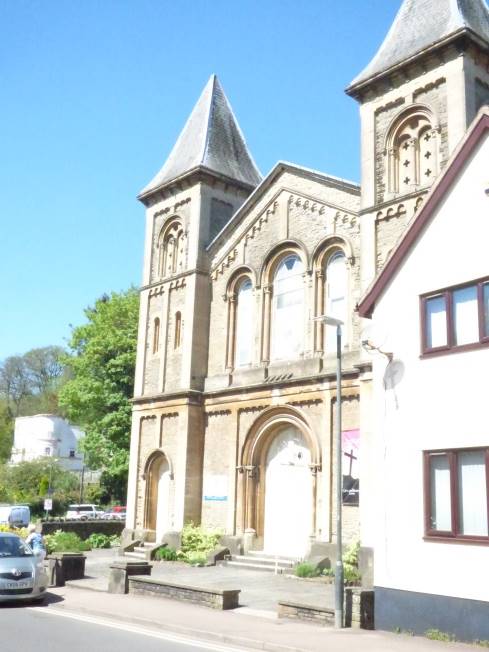 The
church at Coleford (pictured left in 2018) bears the foundation date of 1799. But its
origins go further back, as several attempts had previously been made to
establish a Baptist cause there. The church is also responsible for a branch
cause at Symonds Yat (the chief local beauty spot),
and for the maintenance at the Gorse of a terrace of ten houses (originally
alms houses) set up by a former deacon - Isaiah Trotter. These were modernised
in 1964.
The
church at Coleford (pictured left in 2018) bears the foundation date of 1799. But its
origins go further back, as several attempts had previously been made to
establish a Baptist cause there. The church is also responsible for a branch
cause at Symonds Yat (the chief local beauty spot),
and for the maintenance at the Gorse of a terrace of ten houses (originally
alms houses) set up by a former deacon - Isaiah Trotter. These were modernised
in 1964.
Our immediate concern was for schooling for Rosalie
and Marguerite. Rosalie was transferred to Bell’s Grammar School, a very old
foundation, where the facilities were quite inadequate, but the teaching
tolerably good. She found herself in advance of the work being done in the
equivalent form, but accepted the situation, and used it to give herself a
better foundation. And by the time she left, to go to Queen Mary College,
London, she quite surprised the staff with her achievements. Marguerite went to
the local primary school, and then won a scholarship to the Monmouth School for
Girls. And from there she went to University College, London.
In the garage at the manse there was an auto-cycle,
and with help I learned to ride it, and passed my test on it. When it gave out,
the church bought me a scooter, which served for several years, though it was a
bit temperamental. Then in 1971 we used a legacy from Phyllis’s mother to buy a
Reliant van[2],
which I was able to drive with my scooter licence. Phyllis used to drive her
father’s car before we were married, but all through the years there had seemed
no prospect of our ever possessing a car, and she allowed her licence to lapse.
So now she had to take driving lessons, which were a great trial to her. When
eventually she passed, she was one up on me, as she was qualified to drive a
four-wheel car, and I only a three-wheeler!
One of the highlights of our church life in Coleford came in 1964, when we commissioned Averil Couper for missionary service in Zaire. She was one
of the last to go out by ship, and her luggage (to which as a church we had
contributed) was mislaid at Matadi, the port. After
some months it was found by a Salvation Army Officer, just in time to save it
from being sold off! The period was in the aftermath of the country’s
independence, and Averil was not for some time able
to go to Kimpese to do the nursing work for which she
had been trained. But she did eventually get there, and was held in high esteem
by her colleagues.
In Coleford we found
ourselves within visiting range of relatives who we had not often met.
Phyllis’s cousin, Phyllis Gouldstone, had married a
student from Ely theological college, Ernest Evans, and we attended their
wedding in Ely cathedral in 1941, before our own wedding. He was now vicar of
Chepstow, and they warmly welcomed us to their home there, and later to Llantillio Crossenny (when he had
become Archdeacon of Monmouth), and finally, on retirement, to Caerlean. At this latter place we also visited my mother’s
cousin Dorothy (Moores) married to Arthur Plumley, and they came over to see us.
Also, we had a stream of Canadian
visitors, beginning with Ron and Margaret Platt in 1965 (again in 1973),
Aunt Nora and cousin Nora in 1966, Irene in 1969, and Aunt Olive and Mabel in
1974. It was a joy to receive these visitors, and we had the accommodation to
do so.
We also welcomed David Cook, who now was driving his
own car, and enjoying the freedom it gave him. He came first in 1964, and was
keen to visit Glen Neath, where his school for deaf
children had been evacuated (from Lowestoft) during the war. It was a real
journey down memory lane for him, but a little disappointing, as the building
they had used was now unoccupied and neglected. He came again in 1965, 1967,
1968, and in 1972 with Diane Neal.
Among the sad times during these years were the
deaths of Phyllis’s parents (1963 and 1969), of Aunt Edie in 1964, and of my
parents (1973 and 1974). We were also concerned in another death in 1969. An
elderly lady named Mrs. Padgham lived in a caravan at
the Scowles. She seemed poor, and we tried to be kind
to her. At length she fell ill, but wouldn’t have a doctor. Finally, when she
realised that she couldn’t hold out any longer, she consented to be brought to
our house, the health visitor fetching her. Within a couple of hours, she died.
We attended her funeral at Box, near Bath. It transpired afterwards that she
possessed about £4,000, and left the bulk of it to a cat’s home.
In 1965 I was asked to be responsible for the library
of the Baptist Ministers’ Fellowship, a task I carried on for ten years. It was
one I enjoyed, and in which I benefited, in the opportunity for more extensive
reading myself. In the same year we went to Rawdon to share in the church’s
250th anniversary celebrations.
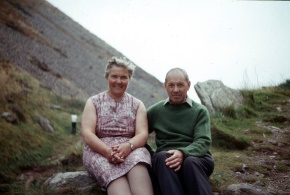 Our
silver wedding came in 1966, and we arranged a holiday at Ilfracombe. We took
Marguerite and stayed for a fortnight, while Bernard and Rosalie joined us for
a week. While we were there, Bernard arranged for a refrigerator to be
installed at the manse, as a silver wedding present - very nice to come back
to. And also while we were there the Severn Bridge[3]
was opened.
Our
silver wedding came in 1966, and we arranged a holiday at Ilfracombe. We took
Marguerite and stayed for a fortnight, while Bernard and Rosalie joined us for
a week. While we were there, Bernard arranged for a refrigerator to be
installed at the manse, as a silver wedding present - very nice to come back
to. And also while we were there the Severn Bridge[3]
was opened.
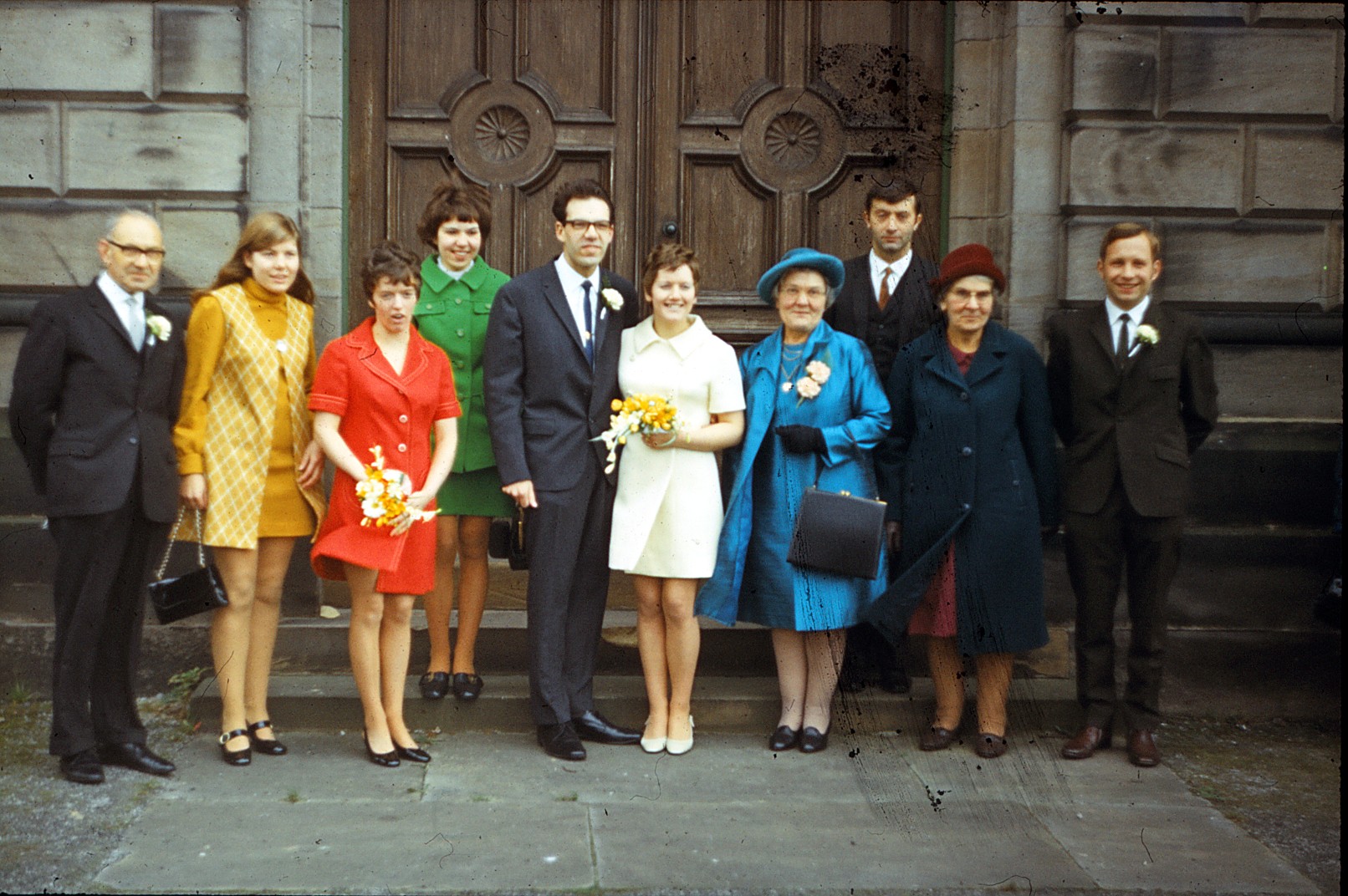
In 1969 we were again at Rawdon for the wedding of
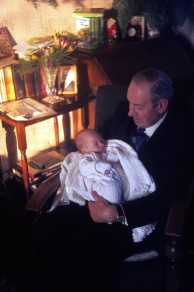
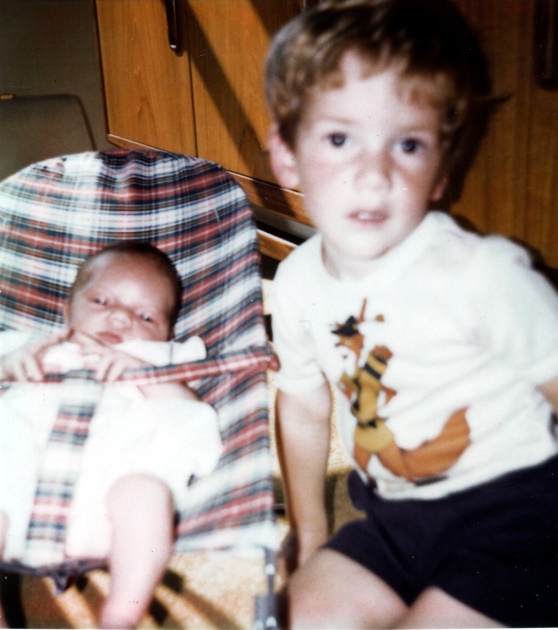
Bernard and Katie. And in 1972 we became grandparents, with the birth of
Adrian, followed in 1975 by the birth of Christopher.
|
|
|
|
|
1969 wedding, with Auntie Winnie
and David Cook |
1972 Enter Adrian |
1975 Enter Christopher |
During our years at Coleford
Phyllis was again associated with the Guide movement, but less formally then
before. In 1963 there was an international Guide camp in the Forest, and
afterwards the visiting girls stayed on in the homes of local Guides. One who
stayed with us was Ursula, from Switzerland. Eleven years later there was a
knock at the door, and it was Ursula, with a husband and two nieces, just
arrived in this country on a holiday. We put them up overnight, and it was a
joyful occasion.
Various other people stayed with us. In 1968 Peter
Jones was over from New Zealand, one of the sons by her first marriage of
Phyllis’s friend Joan Nuth. He was working his
passage, and for the weeks he stayed with us he obtained a job at the Beechams factory. Also Malcolm Hawke found lodging (and
friendship) with us. He was a music student who was glad of a holiday job at
the factory in 1970 and 1972. Some time later we
attended his wedding in Monmouth. We also received a number of students on
teaching practice for a fortnight in the Easter terms.
After teaching for three years at Epsom, Rosalie
applied to the B.M.S., and was accepted for service in Zaire. For the autumn
term 1972 and the spring term 1973 she was at St. Andrew’s Hall, Birmingham.
Then after valediction at the Baptist Assembly she went to Belgium for two
months, and then on to Africa, her first station being at Ngombe
Lutete, and afterwards at Kimpese.
Marguerite gained a place in University College,
London, and for the first term was in digs. But before the term was over, she
had met, at the John Clifford Society, a friend named Alison Charley, with whom
she was able to share a flat. She turned out to be a great niece of Dr. Charley, formerly a scientist at Beecham’s factory, who
in his Coleford days had been Sunday School
Superintendent. The friendship thus formed has continued until the present
time.
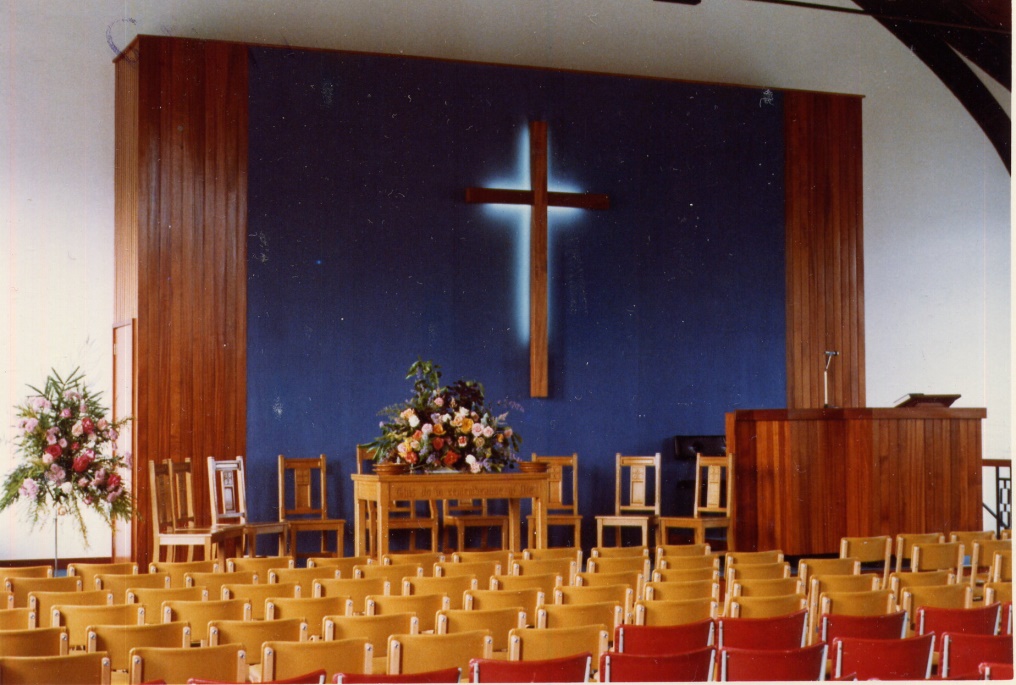
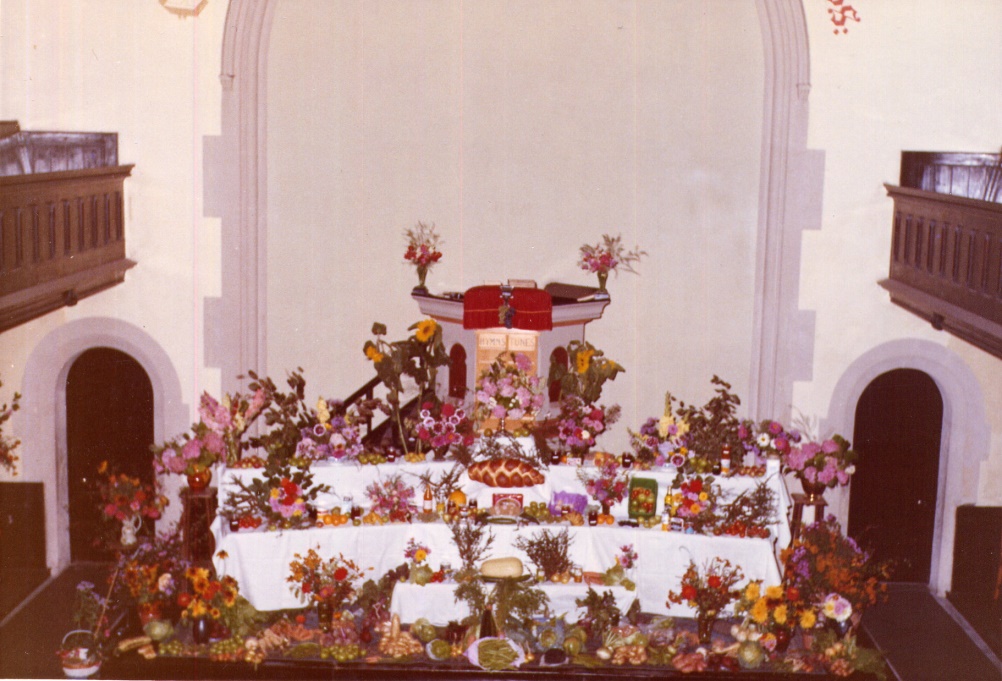 The
reconstruction of the church building (pictures:
before, left; after, right) took place between Sept. 1970 and July 1971.
After lengthy discussion it was decided to try to sell off the original
building (in use as a schoolroom), the suite of classrooms and the caretaker’s
cottage, and to reconstruct the main building on two levels. For this purpose
the building would be reduced to a shell, everything being removed except the
organ[4].
We obtained an architect’s plans, and then put the whole matter in the hands of
Mr. Brain, a Baptist deacon at Ruardean Hill. The
work was still at the dismantling stage, when Mr. Brain died suddenly.
Fortunately his partner Mr. Collier (a church warden at the Forest church) was
fully in sympathy with the project, and carried it to a successful conclusion.
The cost was not great by today’s standards, but it was an ambitious project
for a membership of our size, and we did well to carry it through at that time.
The
reconstruction of the church building (pictures:
before, left; after, right) took place between Sept. 1970 and July 1971.
After lengthy discussion it was decided to try to sell off the original
building (in use as a schoolroom), the suite of classrooms and the caretaker’s
cottage, and to reconstruct the main building on two levels. For this purpose
the building would be reduced to a shell, everything being removed except the
organ[4].
We obtained an architect’s plans, and then put the whole matter in the hands of
Mr. Brain, a Baptist deacon at Ruardean Hill. The
work was still at the dismantling stage, when Mr. Brain died suddenly.
Fortunately his partner Mr. Collier (a church warden at the Forest church) was
fully in sympathy with the project, and carried it to a successful conclusion.
The cost was not great by today’s standards, but it was an ambitious project
for a membership of our size, and we did well to carry it through at that time.
In order to sell trust property, the consent of the
Charity Commissioners is needed, which can be a lengthy process. We decided to
adopt the shorter method of vesting the property in the Baptist Union
Corporation. We tried to persuade the folk at Symonds Yat
to do the same, but without success. So their chapel remains in the hands of
local trustees.
During the nine months that our church building was
unusable, we held our Sunday morning services in the old school room, and on
Sunday evenings we worshipped with our friends in the United Reformed Church.
They had no minister at the time, so the arrangement was of some help to them
as well as to us.
In 1973, during a Sunday morning service, I conducted
an unusual “Blessing of Marriage”. A young fellow, who had been a scholar in
our Sunday school, was engaged as a Flamenco dancer in Spain, where he had met
a young lady whom he wished to marry. She went home to Venezuela, and was there
married to him by proxy. So he met his wife on her return to Spain, but had no
marriage ceremony to remember. They came to this country, staying with
relatives in Bristol. She knew no English, but he obtained the responses from
me in advance, and taught them to her. When the day arrived, they turned up in
their flamenco costumes, and it made a colourful occasion. We invited them to
the manse afterwards for lunch.
I was approaching the age of 65, but still felt in
good fettle. Had I not been at Coleford for as long
as 13 years, I might have continued there longer. But
it seemed good for the church to have new leadership at this 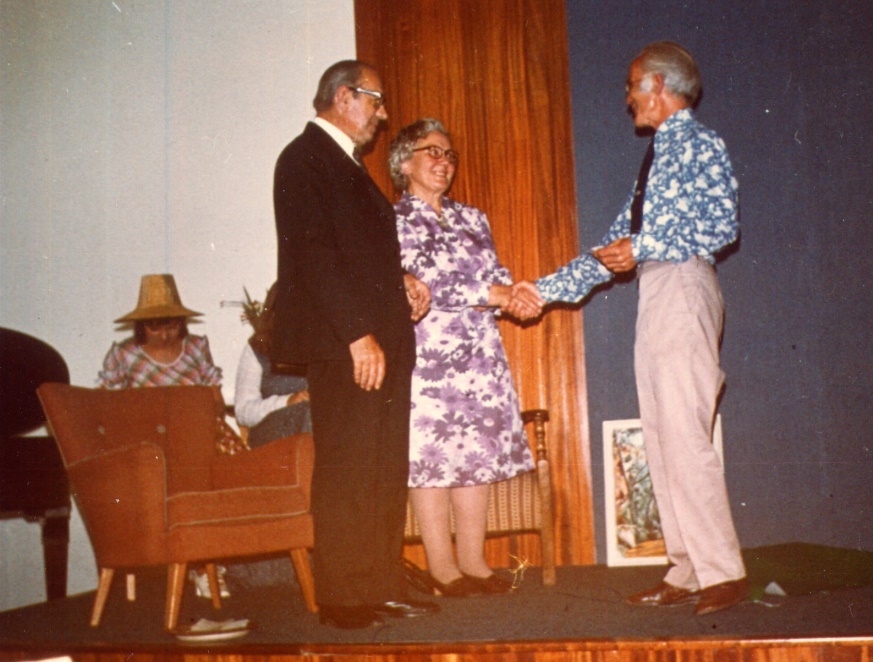 stage.
So I began looking for a small church that I could serve in semi-retirement.
Bernard’s minister (Mr. Webster) was then secretary of the Bucks. Baptist Association,
and through him I learned of the need at Little Kimble. The matter went through
the “usual channels”, and we eventually left Coleford
in August 1975.
stage.
So I began looking for a small church that I could serve in semi-retirement.
Bernard’s minister (Mr. Webster) was then secretary of the Bucks. Baptist Association,
and through him I learned of the need at Little Kimble. The matter went through
the “usual channels”, and we eventually left Coleford
in August 1975.
With the assistance of Rosalie (who had come home
from Zaire 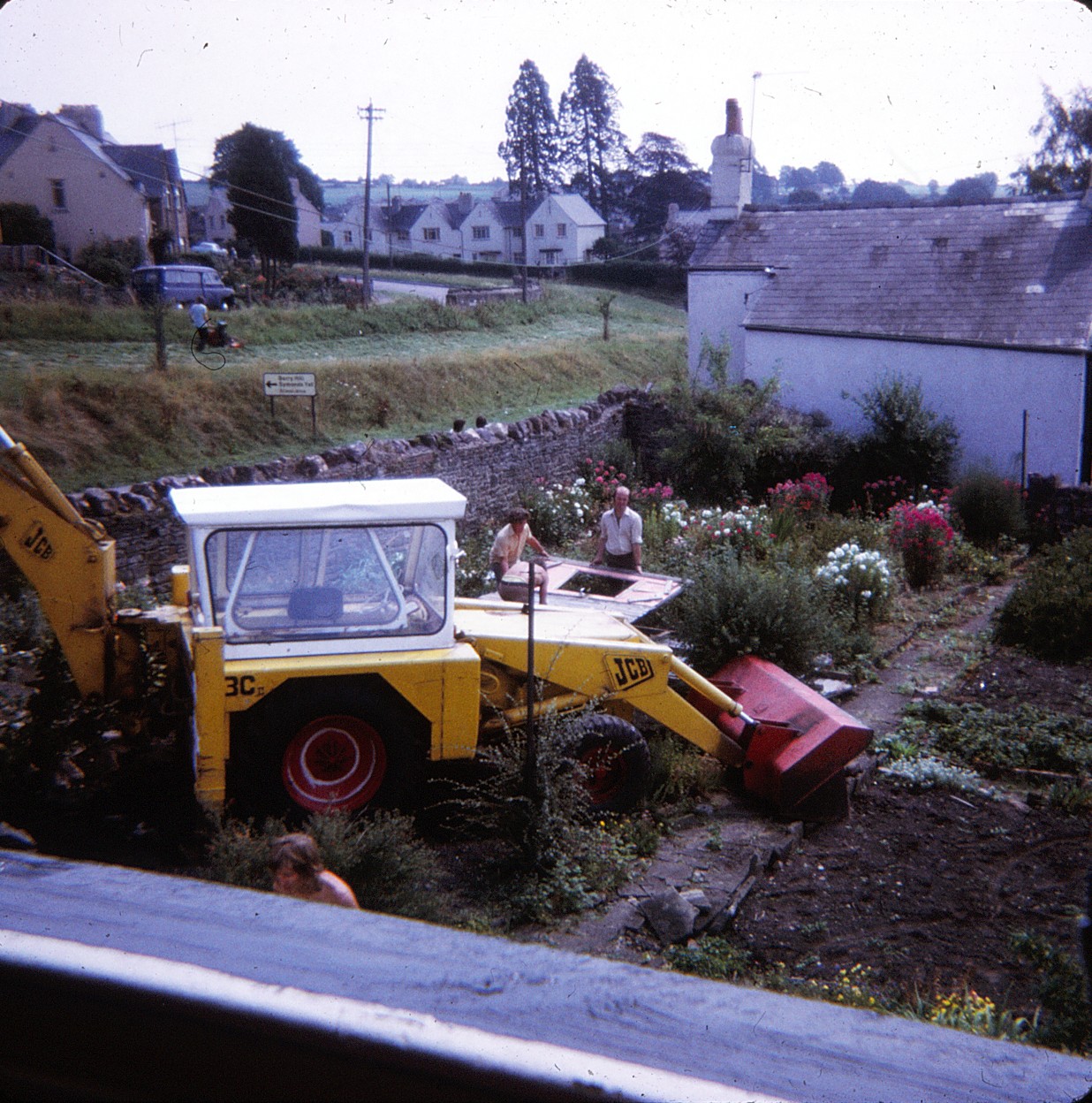 to help
in our “transplant”) and Marguerite, the church put on a “This is your Life”
programme, by way of farewell. Phyllis and I hadn’t a clue about the nature of
the evening, but it proved a very happy and relaxed occasion.
to help
in our “transplant”) and Marguerite, the church put on a “This is your Life”
programme, by way of farewell. Phyllis and I hadn’t a clue about the nature of
the evening, but it proved a very happy and relaxed occasion.
In
the meantime, the church had decided to sell the manse, which needed to have a
lot of money spent on it, and to put up a new building on the garden. So it
came about that as we were moving out, the “digger” was beginning its
operations.
Click here to continue to the next
“chimney”, or to return to the title page.