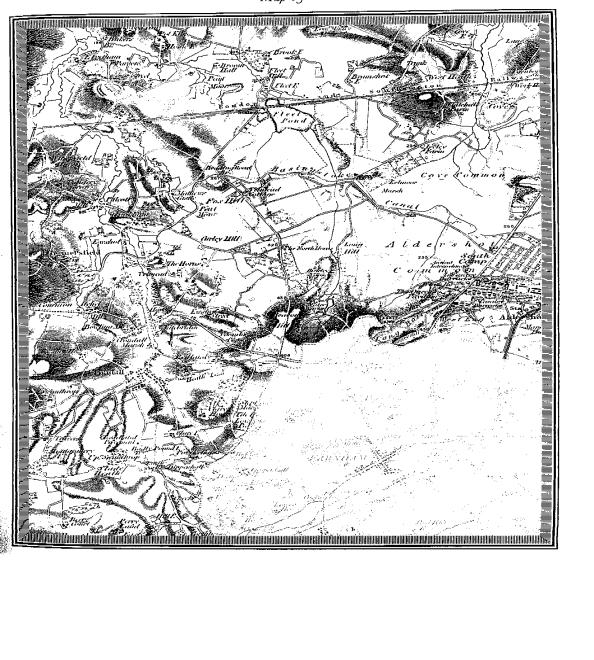
And now to tell you somewhat of the neighbourhood. To the S.W. (footnote 1) was Elvertham the estate of Lord Calthorp as before stated, and reached in a N.E. direction to within ½ a mile of our house. This estate was bounded on the N by another, owned by Railks Currie, a banker, and on the S. and W. by Mildmay Park the seat of Lady Mildmay and afterwards by her son Sir John. These 3 estates covered miles of country and contained many farms and villages, and of course their owners were the lords of creation, and other people very small fry. The other large landowner was the War Department, and there were miles of heather, furze [22] and broom, with scarcely one house to the square mile. Away from the main road just one other estate which joined Railks Currie's, Minley Manor, was owned by the Rev H. D. -, a fox-hunting parson; he preached once a year, at least - had to, to keep his living - and had a curate to do duty, so I understood. He and his son and 2 daughters used to 'ride to hounds' as it was called; sometimes the daughters got thrown and broke a limb, but that did not stop them.
The towns around
were Aldershot (5 miles), a military camp with usually 20,000 men there,
the gun fired at all military camps for
when the time was at 6am, 12 noon and
9pm, so we had official i.e. Greenwich time 3 times a day.
Farnham (6 miles away) was in the
next county of Surrey, where a cattle-market was held one day a week, and where
at Farnham Castle was the official
residence of the [23] Bishop of Winchester, who had quite a herd of deer in his
park, usually. About halfway between
Fleet and Farnham was Beacon Hill and Caesar's Camp (footnote 2), and the names explain the places; doubtless
beacon fires were lit, on occasion, on beacon Hill, and Caesar most likely had
a camp there as it was the highest point for many miles around, and good for
observation. Also within 2 miles was
the waterworks that supplied the camp with water, then some miles of very sandy
soil known as the long valley, where sham fights used to be staged and where
also was the steeple chase course, mostly for the use of military officers and their friends. Originally a steeplechase was a
cross-country race one Church steeple to another, but this was a racecourse
with fences and water jumps, where often spills occurred. There were usually
military bands in attendance playing near the grandstand,
[24] There were
many farms around within a few miles, principal crops raised were wheat, barley
oats and hops, also roots for cattle and sheep. There was also a brickfield
within 2 miles, and 2 grain mills, one at 1½ miles and the other at 2 miles
S.W., both water-powered. There was also a farm that had clay that was good for
pottery-making, and those people made flower-pots and saucers, covered and open
pans, etc.; they also kept goats and on occasion killed one for eating. The thatching of houses, and stacks,
well-digging, hedging and ditching, made work for many beside the regular farm
work.
Beyond Hartley
Wintney was the Duke of Wellington's seat at Eversley, and where at the church
ministered the writer of "Westward Ho!", and other books and tales,
the Rev Charles Kingsley.
Click to view a
map of the Fleet area, circa 1865 (Fleet is top centre)
I did not notice
it then, but in after years I remembered the birds. The songbirds, the skylark, linnet, thrush, blackbird,
nightingale and many others too numerous to mention [25] and more than I knew
about. Then there was the cookoo,
spelling doubtful (footnote 3), and the swallows which nested under the eaves of our house, whose
flying was most swift and graceful. Birds of gay plumage were few, notable
mention the kingfisher; game birds were plentiful on the large estates, because
they were bred to shoot - partridges and pheasants; the latter had beautiful
plumage. Then there migrated overhead ducks, geese and swans, the latter from
Dogmersfield Park to Fleet pond. Of fish I can say but little, the results of an
afternoon fishing were so meagre, I was discouraged and rarely went, but there
were a few roach, perch and dace - the largest I ever saw weighed ½ a pound.
But swimming - we boys enjoyed it to the full, both in canal and pond, and would
sometimes stay in the water the whole of the afternoon. Birds nesting was another joy, and climbing
the trees for them half the fun, also collecting the eggs after being blown;
but it came to my ears [26] that it was unlucky, and so desisted; we did
occasionally eat the eggs raw, if good - the first test was to see if they were
clear; if opaque, they had been sat on for too long.
The military
manoevres and marches, sham fights and reviews, the steeple-chases and races,
the fox-hunting, provided lots of entertainment for boys, and those also of
older growth.
The London & SW Railway was the one that served Fleet on the direct line from London to Southampton, and the first in a SW direction; the London to Portsmouth was years later, branched off at Woking and went through Aldershot, Farnham, Alton etc. – also the extension from Southampton to Bournemouth and the West later still.
There was a canal which flowed from the Thames to the Hitchen (footnote 4), but which was reported to have been bought by the Railway Co to eliminate competition, and was allowed through disrepair to go into disuse as a carrier of cargo. There was a wharf at Fleet (footnote 5) and for years [27] timber was landed there; I saw it.
Then there were the game-keepers to the different estates, with their velvet coats and their corduroy trousers, others who raised fox-cubs, and rat-catchers with their dogs and ferrets; and the latter such excitement if an old hayrick had to be thrashed, as they invariably harboured rats. Then there was the broom dasher, who made garden brooms of birch, stable brooms and cottage-yard brooms of heath, for short brooms, heather. Also the turf-cutter, who with a turfing iron would turn up hundreds and thousands of heather turfs for household fires, the original fuel before coal was used for that purpose; and there were those who made hurdles for sheep-folds, and there were others.
Now to note some of the characters. First the Anglican minister, whom most people respected, if they did not hold with his tenets; and his wife, to me a most amiable and gracious lady. This good man was liberal in his sympathies, even to arranging a weeknight service at [28] the Church, and inviting the Baptist minister to take part; this speaks volumes, for things as they then were. One of the church wardens was road surveyor, and had a few acres of farmland. The organist was a retired gentleman, who had his money in Turkish bonds, and who at the conclusion of the Russo-Turkish war of the 1890’s had lost most of his wealth. Then there was the man of commanding presence whom we called Lord -; I think he had been Governor of some British possession, perhaps the Windward Islands. The doctor also, a churchwarden, came to Fleet to retire from work and supplied the need; his wife used to come to the morning service at the Baptist Church. We had at the Baptist Church as leader of the singing, a retired exciseman (footnote 6) but who understood music, until he either died of went away, and my [29] sister Maria took on the duties of organist etc.
A little later the Primitive Methodists had a little chapel built, and they used to have outdoor camp meetings, usually at the Canal Wharf, and people used to sit on the timber, but they were a very noisy crowd. I remember a very sedate Anglican, a retired lawyer, came into the shop on the first Monday morning following the first Methodist camp-meeting, and with surprised look and gesture exclaimed “I wondered what was the matter” – he had heard the commotion ½ a mile away, and had come to see who and what it was all about. They made a considerable stir, but some continued to come to the morning service at the Baptist Chapel, which really was the first place of worship built there.
I used to ride on the brick carts that brought the brick to build the All Saints Church. I had a man friend George Stacey, a small farmer, who used to supplement his income by what we called [30] carting, in some places "cartage" and in others "haulage" or "hauling", and he sometimes worked for my father. Also he had 2 sons, George who enlisted in the artillery and played first cornet in the band at Woolwich (the band never went abroad or colonial or foreign service), and Johnnie the other son, who had a donkey and cart, and with which he collected and took home laundry work, done by his mother. I used to visit there and occasionally have a ride in the donkey cart, or on the donkey, back to have a meal with them; and it is there I had for the first time tea without milk. And the reason - those who could, kept a cow, and those that did not went without milk, that is, broadly speaking. There were some who kept cows who sold to anyone who came for it, but no milk was delivered, and there were exceptions to that rule too. I remember old C. brought our milk one morning, and my mother found a slug of tobacco in the milk, and so no more milk from Old Carpenter. [31] Well, John Stacey used to visit me and come to a meal, and what he enjoyed so much was to go and help himself to strawberries out of the garden.
Another friend, also a small farmer and who worked for other farmers, was Johnathan Ely; he used to be coming home from work with his team (footnote 7) when I came out of school, and he used to pick me up and put me on one horse while he rode the other. Another friend was a strong big fellow named Charlie Young, and one of my earliest recollections was of my going to meet him, coming home from work, and he would pick me up and carry me on his shoulders home. Also I used to go for walks with an old gentleman who kept the Oatsheaf Inn, our nearest neighbour, and he pointed out a culvert under the road by which a stream of water was diverted from one side of the road to the other; it was only flood water, no real permanent stream. Then there was a Mr and Mrs Henbury, people retired from business, but I used [32] to visit them, have a meal, go round the garden, and sit and talk; it was he who told me they kept two bears in the house - bear and forbear. I can believe he bore, but she looked rather a miserable, peevish etc. woman, however she was all right to me. He was a real gentleman, used to attend the Baptist Chapel. But my friend all through was George Goddard the shoemaker, one of Mr Webster's first converts and one of the best; his disposition was one of the best, it would be hard work to offend him; his workshop was the meeting place for all and sundry, like the blacksmith's shop is in most places, and he was always good for a joke - sometimes a practical one, as for instance he gave my brother Sam a piece of cobblers wax one day, and so that it should not stick to his pocket suggested that he put it under his cap; of course, it stuck to his hair, and some locks of it had to be cut away ere the wax was removed. He had 2 boys, grimy to a degree when small, but they grew up to be prosperous builders; [33] a neighbour builder took them in hand and taught them the business, and they succeeded beyond all expectations, for at that time the War Department sold a lot of land thereabouts, and everyone who could bought lots and built houses, and these 2 boys just fitted in at the time.
Transcriber’s footnotes:
1. NW on the map
2. According to the old guide-book to Hampshire, this had nothing whatsoever to do with any Roman Emperor.
3. cuckoo
4. Probably the Itchen, the river near Southampton.
5. Cannot be seen on the map (diary page [22]), but is probably the wharf at the bridge where the Reading road crosses the Canal; the canal is used now for pleasure boating. The diary (page [29]) says the Methodist chapel was built there, and that is the site of the original Methodist building.
6. Nowadays called Customs and Excise; collector of duties to be paid on the trade of goods
7. of horses
Click here for the title page, previous section or next section