Chapter
One
On May first, 1908, the steamship “Empress of Britain” sailed out of the port of Liverpool, crowded with people leaving old England for the new land of promise, Canada. Among them were my mother, Lillian Garland Moores, with her three children, Helena Louise (15), Cyril Eric (10) and myself, Olive Octavia (7½ years old).
My father, Thomas Walter Moores (footnote 1), who had been in the grocery business all his life, as was his father before him, had found conditions growing steadily worse. Workers were paid such a miserable pittance that they had scarcely enough for food, and most of them took groceries out on credit. My father could not refuse food to hungry women and children, even though he knew that the men spent some of their hard-earned money on liquor, and that the bills would never be settled. So, although Father worked long hours and did his very best, eventually he went into bankruptcy and lost everything.
My oldest brother Leonard, with an uncle and a cousin, had left for Canada the previous year, and now wrote suggesting that Father and his second son, Eustace, go out and join them. So, after seeing Mother and the rest of us settled in a house in Teddington Middlesex, owned by my mother’s brother, Father and Eustace left in the spring of 1906.
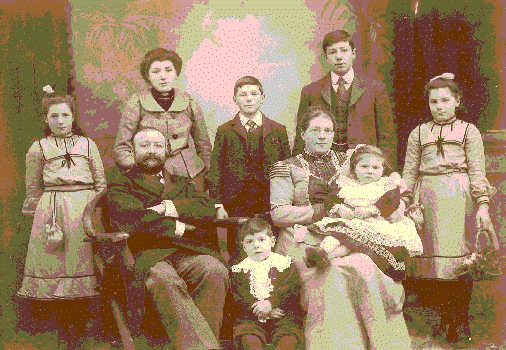
T W and Lillian Moores and family, prior to leaving for Canada
(L to R: Back: Nora, Mabel, Eustace, Leonard, Helena; Front: Cyril and Olive)
(taken, presumably, shortly before their departure to Canada)
Those next two years must have seemed dreadfully long to both my parents. Mother had full responsibility for her four youngest children, while Father had to find land, build a house, and establish a place for us to live together again.
[2] The glowing advertisements sent by the Canadian Government and the C.P.R. (footnote 2) stated, among other things:-
One
hundred and sixty acres of land, FREE!
Roads
– Schools – Churches
And
NO TAXES!
Well, when we arrived there were NO roads. We had no school in our district ‘till 1918. Our “Church” was a little log-shack put up by the settlers, about 1910, where they carried on a Sunday School. Most of the services were held by a retired Presbyterian minister, of whom more later. And OF COURSE there were taxes to be paid, or the land would be taken away and sold to someone else.
Father and the boys filed on two homesteads about 8 miles from Invermay, Saskatchewan. It was covered with bush and sloughs (footnote 3). They cut poplars, and put up a little one-room shack to live in while they went out looking for work. The only jobs they could find were with the C.N.R. (footnote 4). The steel had just gone through but, being laid down on the prairie sod, it could not stand up for any length of time, especially under heavy loads, so had to be constantly repaired, especially when the rains came and turned the earth to mud. So they worked very hard, loading and unloading gravel by hand, building up the road-bed from June ’till October the 28th. Then they returned to Invermay, bought lumber to make doors for the shack, built bunks with willow staves, filled gunny sacks with hay for mattresses, and settled in for the winter.
Leonard dug a cellar on his homestead ready to put up a shack. This was mandatory before he could get title to the land, and one day Father fell into this hole when it was frozen hard as iron, and hurt himself so badly that he could not move. The boys borrowed a team of oxen and a stone-boat, and took father home, where he laid for ten weeks before [3] being able to stand, and gradually to walk again. My poor mother must have been terrified (if she even knew of the accident). I know that she wrote and asked Father if it was very dangerous working on the railroad, and he replied “If you could see the tracks, you would know that it is far more dangerous to ride on it!”
In 1907, the two boys went out to look for work in the Yorkton area, Father staying at home to help his younger brother, Samuel Moores, with haying and harvest. Uncle and Aunt had come from England early in 1905, and were more firmly established, having cows, oxen, a team of sorrel bronchos from the old “45 ranch” in southern Alberta, and quite a large flock of sheep.
So here were four more of the family on board ship, on the way to becoming a united family again – though not quite! My oldest sister, Mabel, the first-born of the family, had been married last Christmas Eve in England, December 24th 1907. As she married an only son, there was no question of their coming to Canada, and leaving his parents. So my oldest (footnote 5) sister Nora was left there too, to be company for Mabel; she would not feel quite so deserted by the family.
After a voyage which seems, in my memory, to have been most pleasant, we landed at Montreal. All I can remember of that place was that we three children were left alone in a huge, draughty building. Mother seemed to have deserted us! No doubt she was seeing about the luggage and getting through Customs, or the Immigration Offices. At last we were on a train packed full of “settlers” setting out on the long journey across Canada to our new home. One thing sustained us; Father was waiting for us. He would be meeting us, Mother assured us over and over again. I do not remember much about those five or six days of travel except that once, in the middle of the night, my brother and I were wakened and lifted down from the shelf on which we slept. The train had stopped at Fort William, and our uncle Arthur (footnote 6) had come aboard to greet us. He brought us a bag of oranges – that is why I remember the episode.
[4] My next memory is of the train stopping at Invermay. We all happily descended, and looked about us. On the south side of the track was a solid bush of poplar trees. On the north side of the platform, the station house; across the road, a small grocery store, the hotel, and one or two other buildings. But where was Father? Mother was greatly disturbed. She had been brought up on the theory that one must NEVER speak to strangers, but was also taught “If in doubt, ask a policeman”. So, seeing a man in ragged pants and a plaid shirt, yet with the word “Police” plainly visible on his suspenders (footnote 7), she ventured to inquire if he knew Mr Moores. “Oh sure”, he replied, “he’s been to meet the train every day this week. Don’t worry, he should be along soon”. Sure enough, in about half an hour, a huge team of oxen drew alongside hitched to a heavy farm-wagon with double tier grain box, the whole outfit borrowed from Uncle Sam. I was lifted in, our bags loaded, the others scrambled aboard, and we were off.
It was the spring of the year; all the sloughs were full of water. There was no road, just a trail winding through the trees and round the sloughs, if possible. Presently we came to a “prairie fire”, so-called, but really a bush fire. It was all round us, but we passed through. Then when navigating a deep slough, one of the oxen laid down in the water, and refused to get up; mosquitoes were dreadful, and the poor creature was seeking relief from the tortuous stings. It so happened that a farmer living nearby, one Hamilton Brown, heard Father shouting, and came along to help. He asked the name of the ox, and with a long flexible willow gave a mighty yell “JACK” as he laid on with the whip, and so scared the poor beast that he leaped to his feet, and we were again on our way. This Hamilton Brown was quite a well-known character at Invermay for many years; he married a Miss Lloyd, whose mother lived beside the railroad track, right on the trail out to our place. She had a fine garden, and often in the years that followed we would pause at her place for a rest and a chat on our way to town, or going home again.
On this particular day, after going a few more miles, Leonard and Eustace came on foot to meet us, and fairly [5] soon we drew up to the big log-house of Uncle Sam and Aunt Margaret. Auntie had a big meal ready for all of us, and it was a happy reunion. Auntie was particularly glad to see Mother, as she had been the only woman for some miles around. She and Mother had always been good friends. Auntie and Uncle had stayed with us in England after they returned from some years in India (footnote 8), and before leaving for Canada. Mother and Aunt remained good friends all through the years on the farm. The two homes were about a mile apart, and there was much going back and forth. I was often a messenger, carrying “notes” between the two.
On this lovely evening in May, after the supper of welcome, we all walked down to the new home. I believe Father was rather proud of the place, but actually it was a rather poorly built log-house of four rooms, two up and two down, with a lean-to kitchen built across the back. It was roofed with sods, floored with rough boards, and in the kitchen a hard dirt floor. The building logs were not even peeled. Father had not realized how needful it was to peel, and then season them, so they were green and full of sap. In the wintertime, when the sap froze, there would be loud bangs like cannon shots, as the logs split all night long.
The beds were built in of poplar poles, very uneven and bumpy, with aforementioned straw mattresses at first. However, about a week later the rest of our possessions arrived by freight train, including Mother’s precious feather beds, and these made a much softer and warmer sleeping surface, though they had to be shaken up and smoothed out every day, so that making the beds was quite a task, and one with which I was supposed to help from an early age.
When the men drove to Invermay to fetch the “settlers effects”, they took the ox-wagon, and all the things were carefully loaded up; but part way home the wagon bogged down in a very deep and muddy slough. Then all the efforts of the oxen failed to move it. Father and the boys had to unload trunks, organ, feather beds and all, carry piece by piece to dry [6] land; then jack up the wagon with poles, and eventually get it out. Then the loading process over again. It must have been very late when they reached home. Mother was worried about her feather beds amidst all that muddy water, but though the men were soaked to the skin and covered with mud, the precious beds were safe. So we settled down to life in this strange new place.
Transcriber’s footnotes:
1. See T W Moores own autobiography, which describes more fully his earlier life in England, and the circumstances leading to his emigration.
2. Canadian Pacific Railway
3. Bogs or marshes.
4. Canadian National Railway?
5. Next oldest – Mabel was the oldest. Perhaps “the oldest of those in Canada”?
6. Youngest of T W Moores siblings – from this description, it seems that he had settled in Canada some time earlier.
7. Bracers to the English!
8. See T W Moores autobiography for further details.
Return to title page, or link forward to the next chapter.